

Table of Contents
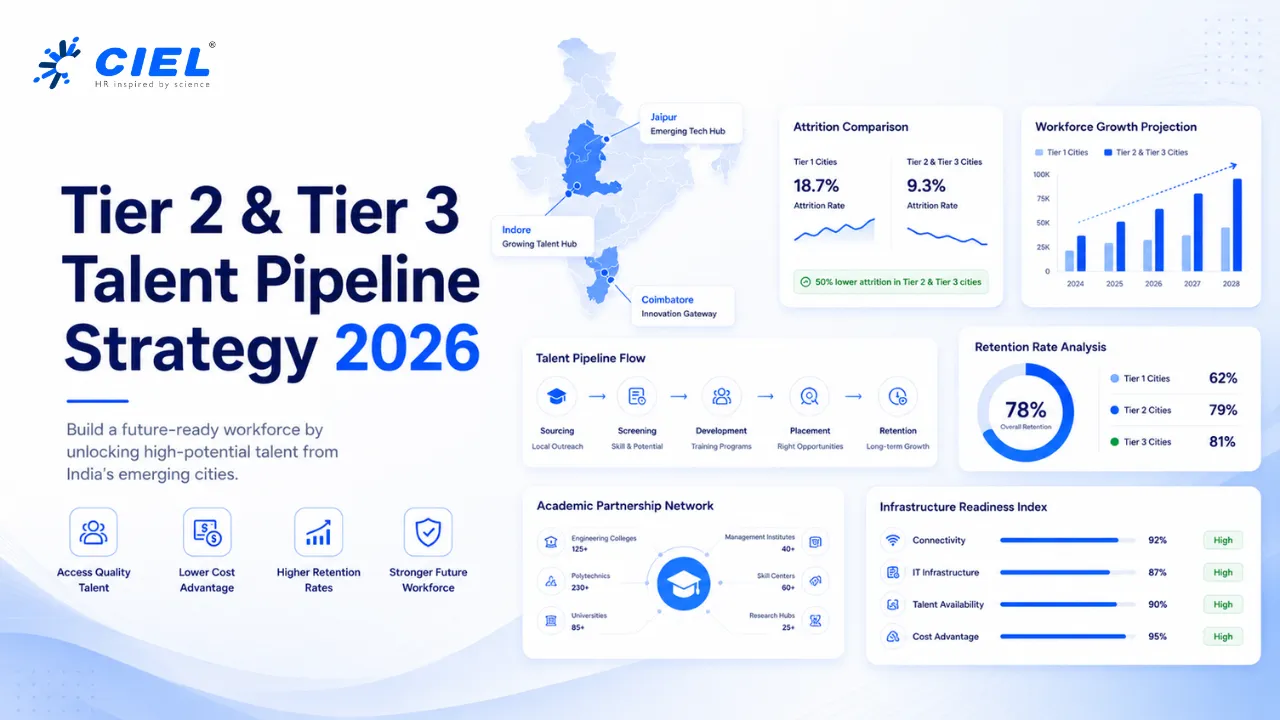
Building a tier 2 and tier 3 talent pipeline in India establishes a localized workforce ecosystem by partnering with regional institutions to train and deploy specialized skills. This strategy reduces urban attrition rates, lowers operational overhead, and secures long-term capacity for enterprise scaling outside saturated metropolitan hubs. Enterprise growth stalls when organizations rely exclusively on saturated metropolitan hubs for their workforce requirements . Operations leaders face escalating compensation demands, high turnover, and a shrinking pool of available candidates in major cities while vast demographic potential remains untapped in emerging regions. The competition for existing professionals creates a zero-sum environment where businesses constantly poach from competitors rather than expanding the total available talent pool.
This concentration persists because traditional recruitment models prioritize immediate hiring convenience over sustainable capacity building. Companies attempt to extract talent from smaller cities and relocate them to tier 1 centers, rather than establishing the operational infrastructure necessary to support a skilled workforce locally. This extraction model inevitably leads to burnout, high relocation costs, and eventual employee migration back to their hometowns or to higher-paying metropolitan competitors.
How Does Tier 2 and Tier 3 Talent Pipeline Development Work?
Distributed talent pipeline development integrates localized university partnerships with enterprise upskilling frameworks to cultivate job-ready candidates directly in emerging markets. This mechanism reduces dependency on tier 1 cities and generates a scalable workforce ecosystem capable of sustaining long-term operational demands. Strategic talent pipeline development connects regional academic institutions to corporate training platforms where enterprises co-develop curriculum, generating a sustainable influx of skilled professionals within 12 to 18 months.
Organizations execute this strategy by identifying which tier 2 cities in India are emerging as the next major tech or innovation hubs, such as Coimbatore, Indore, or Jaipur. Instead of setting up a passive recruitment office, the enterprise deploys training infrastructure directly into these ecosystems. The focus shifts from filtering existing resumes to actively manufacturing the exact skill profiles the business requires. This approach unlocks the long-term strategic benefits of developing talent in tier 2 Indian cities beyond cost savings, establishing a loyal, highly calibrated workforce.
What Happens When Enterprises Shift to Regional Talent Hubs?
Regional talent deployment shifts workforce operations from centralized metropolitan offices to localized delivery centers, stabilizing retention through community integration. This approach mitigates the rapid turnover typical of transient tier 1 workforces.
A global financial services firm operates a massive processing center in Mumbai, battling a consistent 35% annual attrition rate . Every month, the talent acquisition team scrambles to replace 50 analysts who leave for marginal salary bumps at neighboring firms. The onboarding backlog grows, project delivery slows, and the training budget balloons. The system functions exactly as designed for a hyper-competitive tier 1 market: it churns.
The same operation running a distributed pipeline in Coimbatore looks fundamentally different. The firm partners directly with three local engineering and commerce colleges, embedding a proprietary data analysis certification into the final-year curriculum. When graduation day arrives, the enterprise does not post job ads; it activates a pre-trained cohort.
On a Monday morning in the Coimbatore delivery center, 40 new analysts log into their workstations. They already understand the firm’s compliance protocols and software architecture. Because the firm invested in local infrastructure and leadership rather than forcing relocation, the attrition rate drops to 12%. The enterprise stops fighting for transient talent and starts operating a self-replenishing workforce engine.
How Does Regional Talent Development Compare to Tier 1 Sourcing?
Regional talent frameworks prioritize structural capacity building over transactional recruitment, altering the economic and operational dynamics of workforce management . This distinction dictates whether an organization experiences chronic turnover or sustainable scaling.
| Feature | Tier 2/3 Pipeline Development | Traditional Tier 1 Sourcing |
|---|---|---|
| Core Focus | Long-term capacity building | Immediate vacancy fulfillment |
| Attrition Rate | Historically lower (<15%) | Chronically high (25-40%) |
| Academic Integration | Deep partnership and co-creation | Superficial career fair presence |
| Cost Structure | High initial setup, low operational cost | Low setup, escalating compensation demands |
What Are the Operational Requirements for Non-Metro Deployments?
Non-metro deployment readiness requires baseline thresholds across infrastructure, academic density, and leadership presence to ensure operational continuity. Failing to meet these baseline metrics results in stalled implementations and localized talent drain.
- Academic Density: Target region must have >5 accredited institutions within a 50km radius = PASS. Fewer than 5 = HIGH RISK.
- Infrastructure Readiness: Commercial real estate availability with minimum 99.9% power SLA and dual-ISP fiber connectivity = PASS. Single ISP dependency = FAIL.
- Local Leadership Allocation: Ratio of senior management to junior staff must be <1:15 during the first 24 months = PASS. Managing remotely from a tier 1 city = HIGH RISK.
- ROI Validation Timeline: Break-even modeled at 18-24 months = PASS. Expecting immediate cost parity within 6 months = FAIL.
What Are the Considerations Before Implementing a Regional Talent Strategy?
Expanding into emerging markets introduces distinct operational constraints that organizations must navigate before committing capital. Acknowledging these limitations prevents misaligned expectations regarding deployment speed and immediate cost offsets.
- Not suitable when the organization requires highly specialized niche skills immediately.
- Requires significant upfront investment in physical infrastructure and leadership relocation.
- Demands strict remote management and compliance frameworks to maintain parity with headquarters.
- Success depends heavily on the long-term commitment of executive sponsors to weather the initial setup phase.
How Can Organizations Begin Exploring Regional Expansion?
Evaluating emerging labor markets requires a systematic assessment of academic partnerships, infrastructure, and internal management readiness. Initiating this assessment provides the data necessary to architect a resilient workforce strategy.
Explore comprehensive frameworks for distributed workforce planning and discover how to map academic partnerships effectively to build a sustainable pipeline.
Frequently Asked Questions
How do companies successfully partner with local colleges in India to build a talent funnel?
Enterprises partner with regional colleges by co-developing specialized curriculum, providing guest lecturers from corporate leadership, and offering guaranteed internships. This integration ensures graduates possess the exact technical competencies required by the organization upon graduation.
What is the expected ROI timeframe for establishing a talent hub in smaller Indian cities?
Organizations achieve return on investment within 18 to 24 months. The initial capital expenditure for infrastructure and training is offset by a 20% to 30% reduction in real estate costs and significantly lower attrition-related replacement expenses.
What are the main challenges when building a talent pipeline in tier 2 and tier 3 India?
The primary challenges include securing reliable commercial infrastructure, convincing senior leadership to relocate for local management, and bridging the gap between theoretical academic knowledge and practical enterprise application.
What is the role of local leadership in retaining talent in non-metro locations?
Local leadership provides essential mentorship, enforces corporate culture, and demonstrates clear career progression paths within the regional office. Without senior leaders present, junior staff migrate to tier 1 cities seeking advancement opportunities.
How to measure the success and ROI of a talent development program in smaller Indian cities?
Success is measured using specific operational metrics, including the 12-month retention rate of new hires, the reduction in time-to-productivity, and the comparative cost-per-hire against tier 1 benchmarks.
What kind of infrastructure is necessary to support a skilled workforce in tier 2 cities?
Supporting a skilled workforce requires enterprise-grade commercial real estate featuring redundant power supplies, high-speed fiber internet with secondary failovers, and secure data compliance environments that mirror global corporate standards.
