

Table of Contents
The best approach for maximizing scalability in the Indian manufacturing sector is greenfield development because it allows organizations to design custom facility layouts from the ground up. This method integrates Industry 4.0 infrastructure and modular expansion capabilities directly into the architectural topology, eliminating the structural bottlenecks associated with retrofitting legacy buildings.
Why Do Legacy Manufacturing Facilities Restrict Scaling in India?
Legacy manufacturing facilities restrict scaling by imposing physical structural limits on production workflows and automated material handling systems. This constraint forces organizations into fragmented operational models that reduce throughput.
Most manufacturing organizations eventually hit a physical wall where their production demands exceed their spatial capacity. The existing floor space becomes crowded, material flow overlaps with pedestrian traffic, and adding new product lines becomes geometrically impossible. The physical building dictates the business strategy rather than the other way around.
This problem persists because companies attempt to force modern operational workflows into structures built for older eras of manufacturing. Concrete pillars sit precisely where autonomous mobile robots need to navigate. Roof heights cannot accommodate automated storage and retrieval systems. The physical shell of the building cannot be updated without halting production entirely, leaving businesses trapped in inefficient layouts.
How Does Greenfield Development Enable Customization and Scalability?
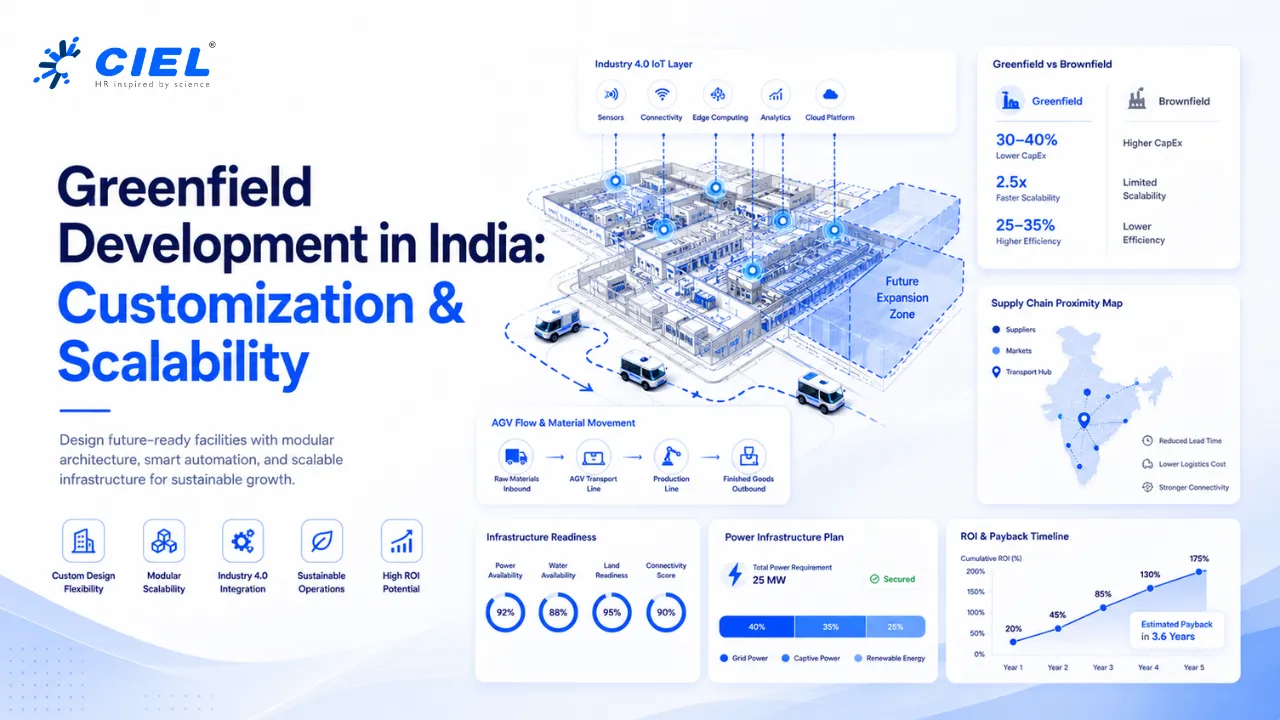
Greenfield development enables organizations to construct custom manufacturing facilities on undeveloped land, aligning spatial layouts directly with optimal production workflows. This architectural freedom generates up to a 30% increase in long-term operational efficiency by eliminating retrofitting compromises.
Understanding how greenfield development in India specifically enables Industry 4.0 and smart factory integration requires examining the foundation-level planning. By starting with a blank slate, engineers embed IoT sensor networks, high-capacity fiber conduits, and edge computing nodes directly into the foundation and structural framework. This deep integration allows smart factory systems to operate without the data latency or signal dead zones common in retrofitted buildings.
To explain the connection between custom facility layouts in a greenfield build and long-term operational efficiency, one must look at material flow. Custom facility layouts optimize the progression of raw materials to finished goods in a continuous linear or U-shaped progression. This precision minimizes material handling times, reduces operational friction, and ensures that every square meter of the facility actively contributes to the production cycle.
What Happens When Structural Constraints Meet Automation Targets?
Evaluating automated logistics within legacy parameters exposes critical workflow failures when physical space cannot support algorithmic efficiency. A greenfield layout prevents these bottlenecks by matching architectural design to machine navigation requirements.
An automotive parts distribution center outside Pune struggles to clear its outbound staging area during the peak evening shift. The facility relies on a fleet of automated guided vehicles (AGVs) to transport heavy pallets from the storage racks to the loading docks. However, the building was originally constructed in the 1990s as a textile warehouse. The support columns are spaced exactly 4.5 meters apart, creating narrow transit corridors that force the AGVs into single-file lanes.
When a single vehicle pauses to recalibrate its sensors or wait for a forklift to pass, the entire algorithmic routing system stalls. Five AGVs stack up behind the delay. The warehouse management software detects the bottleneck and attempts to reroute the fleet, but the physical building offers no alternative pathways wide enough for the pallets. A 30-second pause cascades into a 15-minute delay, dropping the shift’s throughput by 12%. The software works perfectly, but the concrete dictates the reality.
The same operation inside a purpose-built greenfield facility operates without these friction points. The structural engineers designed the floor plan specifically for the AGV turning radius, spacing the support columns at 9-meter intervals and designating dedicated autonomous transit highways separated from human traffic. When an AGV pauses in this environment, the routing engine immediately diverts the trailing vehicles into an adjacent passing lane. The material flow never stops. The physical architecture actively supports the digital intelligence rather than fighting it.
What Are the Trade-Offs of Greenfield vs Brownfield Development?
Evaluating greenfield vs brownfield development for maximizing scalability in the Indian manufacturing sector requires analyzing capital expenditure against long-term operational flexibility. Greenfield projects demand higher initial investment and longer timelines but offer unconstrained physical and digital infrastructure alignment.
| Feature | Greenfield Development | Brownfield Development |
|---|---|---|
| Initial CAPEX | High ($50M+ typical threshold) | Moderate to High (retrofitting costs vary) |
| Layout Customization | Unrestricted | Constrained by existing load-bearing walls |
| Industry 4.0 Integration | Native (embedded infrastructure) | Bolted-on (often requires surface conduits) |
| Time to Market | 18-36 months | 6-12 months |
How Do Modular Designs Future-Proof Expansion Plans?
Modular design in a greenfield project future-proofs a company’s expansion plans in India by establishing pre-engineered expansion zones and utility tap-off points. This strategy reduces future structural modification costs by up to 40% when adding new production lines.
Incorporating modularity means designing the facility with removable curtain walls and oversized utility headers that can support a 50% capacity increase without requiring new substations. When addressing what is the process for selecting a greenfield site to optimize supply chain and logistics in India, organizations rely on strict topological and infrastructure thresholds to validate the location.
- Supply Chain Proximity: Distance to primary national highway < 15 km = PASS. Distance > 15 km = HIGH RISK for logistics delays.
- Power Infrastructure: Substation capacity > 20% above peak projected load = PASS. Action: Require dedicated high-tension line integration if below threshold.
- Topological Expansion: Usable land area > 2x initial building footprint = PASS. Action: Secure adjacent parcels during initial acquisition if expansion space is limited.
What Are the Long-Term ROI Benefits of Environmental Compliance?
Designing for environmental compliance in an Indian greenfield project generates long-term ROI benefits by lowering utility consumption and qualifying the facility for governmental financial incentives. This approach reduces lifecycle operating costs while ensuring regulatory alignment.
Integrating solar arrays, rainwater harvesting, and zero-liquid discharge systems directly into the initial build prevents expensive compliance retrofits later. Understanding how can businesses leverage state-specific subsidies and tax incentives for large-scale greenfield investments involves evaluating the local industrial policy. Organizations offset initial capital expenditures by aligning these sustainable designs with state frameworks, securing capital subsidies, stamp duty exemptions, and electricity duty waivers based on their investment tier.
What Are the Considerations Before Implementation?
Greenfield development carries specific structural and financial limitations that organizations must evaluate prior to land acquisition. Committing to a custom build requires accepting extended deployment timelines.
- Not suitable when time-to-market is the primary business driver, as zoning, permitting, and construction take 18-36 months.
- Requires substantial upfront capital expenditure prior to generating any revenue from the new facility.
- Carries higher risk of initial supply chain disruption as entirely new inbound and outbound logistics routes must be established and tested.
Explore how structured facility planning aligns physical infrastructure with long-term operational targets to build a resilient manufacturing footprint.
Frequently Asked Questions
How does greenfield development integrate with existing ERP platforms?
Greenfield development integrates with ERP platforms by utilizing dedicated server rooms and embedded fiber optics installed during construction. This physical infrastructure supports high-bandwidth APIs, ensuring real-time data synchronization between factory floor sensors and centralized management software without network latency.
What is the typical ROI timeframe for a greenfield manufacturing facility?
The ROI timeframe for a greenfield manufacturing facility typically spans 7 to 12 years. The extended duration accounts for the high initial capital expenditure of land acquisition and construction, which is gradually offset by lower maintenance costs and higher operational throughput.
How does a modular greenfield design work mechanically?
A modular greenfield design works mechanically by utilizing non-load-bearing exterior walls and pre-installed utility junctions capped for future use. When expansion is required, construction teams remove the temporary walls and connect new structural bays directly to the existing utility grid without disrupting ongoing operations.
What role do state subsidies play in greenfield financing?
State subsidies reduce the effective capital expenditure of greenfield projects by offering reimbursements on infrastructure spending. Organizations meet specific investment and employment thresholds to trigger tax rebates, land cost subsidies, and reduced utility tariffs over the first five to ten years of operation.
Why might an organization choose brownfield over a greenfield approach?
An organization selects a brownfield approach when rapid deployment is mandatory. Retrofitting an existing structure bypasses the lengthy permitting, zoning, and foundational construction phases, allowing operations to commence months or years faster than a custom build.
