

Table of Contents
The most effective approach to managing Income Tax Deducted at Source (TDS) and filing cycles involves automating deduction mapping to specific payment types and reconciling challans directly through the TRACES portal. This mechanism eliminates manual data entry errors, ensuring businesses meet strict quarterly filing deadlines and avoid compounding interest penalties.
How do finance teams accurately track statutory deduction rates across varied vendor profiles while preventing late fees? The evaluation of tax management processes determines whether an organization maintains predictable working capital or loses funds to continuous compliance penalties. A proper evaluation framework focuses on identifying systems that intercept payments before disbursement to apply the correct statutory tax rules.
Manual spreadsheet tracking relies on human memory for varying due dates and tax forms, leading to mismatched challan records and delayed tax credit certificates. When finance departments attempt to scale operations using disconnected tools, they inevitably fail to differentiate between resident and non-resident contractor payments accurately. This administrative gap forces organizations into a reactive cycle of filing corrected returns and paying unnecessary fines.
Why Does the Traditional Approach to TDS Compliance Fail?
Manual TDS compliance relies on disconnected spreadsheets to track vendor payments, calculate deduction rates, and monitor quarterly filing deadlines . This fragmented mechanism creates data silos that increase the risk of challan mismatches and late deposit penalties. Finance teams using this approach face compounding interest charges and delayed certificate issuance.
When accountants manually extract data from ERP ledgers to prepare returns, the risk of data transposition errors multiplies. These errors trigger automatic notices from the TRACES portal , requiring immediate rectification. Furthermore, manual processes struggle to map the correct tax codes to the exact date of payment or credit, which is the foundational trigger for tax deduction liability.
What Are the Core Criteria for Evaluating TDS Filing Processes?
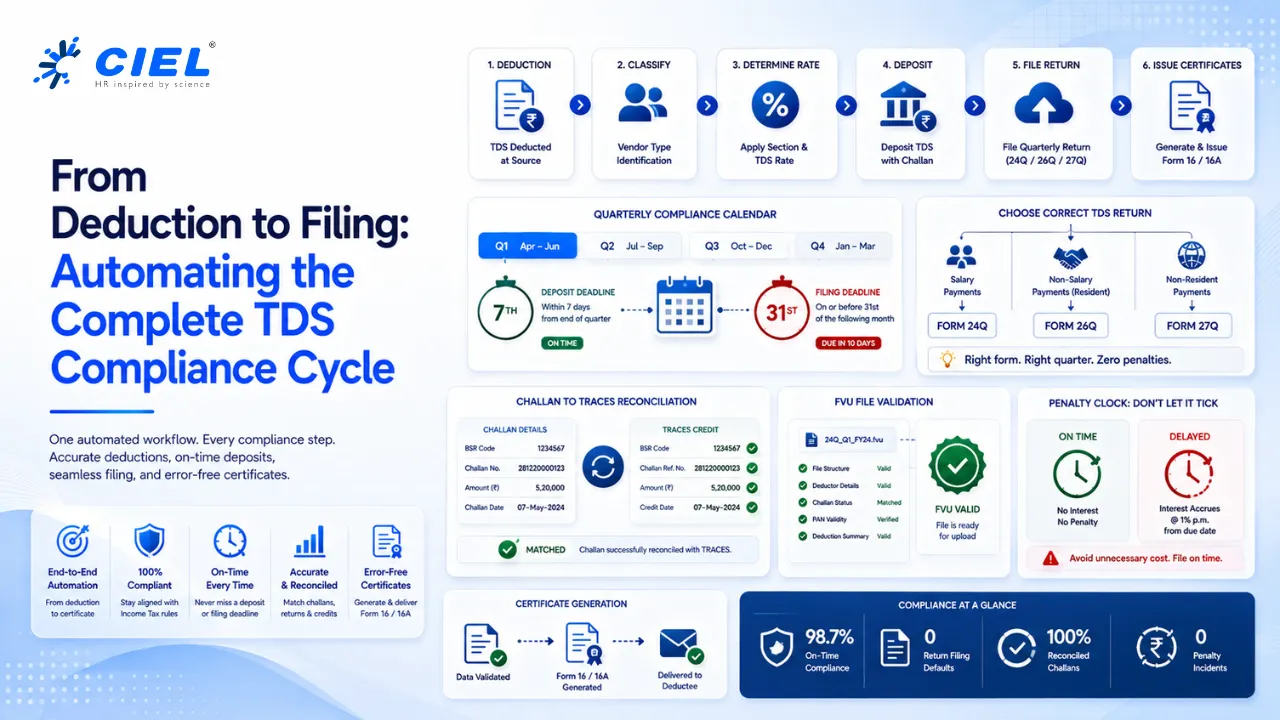
An automated TDS evaluation framework cross-references vendor payment data against statutory tax rates to ensure accurate deduction before invoice settlement. This validation mechanism prevents under-deduction and standardizes the preparation of Form 24Q, Form 26Q, and Form 27Q returns. Organizations utilizing strict validation parameters reduce quarterly filing errors by up to 90 percent.
Finance leaders must implement a complete TDS compliance checklist for a small business or enterprise to validate system readiness. The following operational authority block defines the exact thresholds and decision rules required for a compliant tax infrastructure:
- Vendor Residence Status: IF the payee is a non-resident contractor, THEN the system must route the transaction to the Form 27Q workflow and mandate a Tax Residency Certificate upload.
- Deduction Timing Threshold: Date of payment or credit (whichever is earlier) > 0 days without deduction = HIGH RISK. Action: Halt invoice settlement until tax is withheld.
- Deposit Deadline Check: Deposit date > 7th of the subsequent month = FAIL. Consequence: Triggers automatic 1.5% interest penalty per month.
- Return Filing Verification: Filing date > 31st of the filing month = FAIL. Consequence: Triggers a strict 200 rupees per day penalty.
How Does a Filing Failure Impact Finance Operations?
A failed TDS compliance audit exposes finance departments to retroactive penalty assessments and vendor disputes over missing tax credit certificates. This enforcement mechanism instantly drains working capital and requires extensive manual reconciliation to correct historical filing errors. Businesses caught in this cycle spend weeks negotiating with tax authorities instead of optimizing cash flow.
The mid-market logistics firm, Apex Freight, recently overhauled its vendor payment system to handle a surge in independent driver contracts. During the software selection process, the procurement team prioritized invoice processing speed but completely bypassed native tax deduction validation. They assumed the existing accounting team would manually catch and calculate the required 1% deduction for individual contractors under Section 194C before the 7th of each month.
That assumption failed during the first quarter of scaled operations. The finance team processed over four hundred contractor invoices without deducting the required tax, missing the deposit deadline entirely. When the quarterly filing date arrived, the controller discovered the gap. Because the evaluation criteria missed automated deduction mapping, the company faced a compounding financial crisis: they had to pay the uncollected tax out of pocket, absorb the 1.5% monthly interest penalty for late deposits, and incur the 200 rupees per day late filing fee.
A correctly evaluated compliance platform catches this instantly. If the evaluation team had prioritized automated deduction triggers, the system would have flagged the independent driver vendor class upon invoice entry. It would have automatically withheld the 1%, routed the data to the Form 26Q preparation module, and generated the payment challan prior to the deposit deadline. The controller would have reviewed a pre-reconciled dashboard instead of spending three weeks filing corrected returns and explaining a massive compliance penalty to the board. The cost of prioritizing processing speed over compliance validation directly eroded the company’s quarterly profit margin.
What Is the Difference Between Automated and Manual TDS Filing Cycles?
Automated TDS software integrates directly with ERP ledgers to generate accurate Form 24Q, Form 26Q, and Form 27Q files based on real-time payment data. This synchronization mechanism eliminates the need for manual data transcription and ensures challans perfectly match the quarterly return files. Finance departments transition from reactive penalty management to proactive compliance monitoring .
| Feature | Automated TDS Software | Manual Spreadsheet Approach |
|---|---|---|
| Form Generation | Auto-populates Form 24Q, Form 26Q, and Form 27Q | Requires manual data sorting per specific form |
| Penalty Calculation | Real-time alerts before statutory deadlines | Post-deadline retroactive discovery |
| Challan Reconciliation | Direct API link to the TRACES portal | Manual entry of BSR codes and deposit dates |
| Certificate Issuance | Auto-generates Form 16 and Form 16A post-filing | Manual PDF generation and individual emailing |
Finance leaders evaluating compliance tools must ensure their chosen solution natively supports File Validation Utility generation to streamline quarterly filings.
What Are the Trade-offs of Implementing Dedicated TDS Software?
Dedicated TDS compliance platforms centralize tax data processing but require strict initial data hygiene regarding vendor Permanent Account Numbers (PAN) and tax residency status. This prerequisite mechanism forces organizations to clean legacy vendor master data before activating automated deduction rules . Companies skipping this validation step experience high rates of rejected returns and mismatched challan errors.
Considerations before implementation:
- Legacy Data Quality: If vendor PAN data is missing or invalid, automated deduction engines default to the punitive 20% rate, causing immediate vendor friction.
- Integration Complexity: The platform requires custom mapping to existing ERP payment modules to intercept transactions before the final bank disbursement file is created.
- Training Overhead: Finance teams must learn to navigate the specific error codes generated by the software when returns face rejection by the TRACES portal.
How Do Finance Teams Finalize the TDS Return Setup?
Finalizing a TDS return mandates the generation of a standardized text file through the File Validation Utility (FVU) provided by the tax department. This validation mechanism checks the structural integrity of the data against official schema requirements before submission. A successful validation yields a hash-sealed file ready for upload, preventing downstream processing rejections.
Before committing to a compliance platform , organizations should audit their existing vendor master data to identify missing tax identification numbers and ensure a smooth implementation process.
Frequently Asked Questions
This section provides rapid, authoritative answers regarding TDS compliance mechanisms, penalty calculations, and form generation processes. These standardized responses clarify operational parameters for finance teams evaluating tax management frameworks. Understanding these rules ensures organizations maintain strict adherence to statutory filing schedules.
How does TDS compliance software integrate with existing ERP platforms?
TDS software connects to ERP ledgers via secure REST APIs or flat-file SFTP transfers to intercept payment entries. This integration mechanism extracts vendor tax profiles and invoice amounts, automatically calculating the required deduction before the final bank disbursement file is generated.
What is the typical ROI timeframe for implementing automated TDS filing tools?
Organizations achieve full ROI within six to nine months of deployment. The financial return is driven by the complete elimination of late deposit interest (1.5% per month) and late filing penalties (200 rupees per day), alongside a 70% reduction in manual reconciliation hours.
How are interest and penalties calculated for late TDS deposit and filing?
The tax authority calculates interest at 1.5% per month from the date of deduction to the actual date of deposit. Furthermore, a strict penalty of 200 rupees per day applies for late return filing, capped at the total tax amount due.
What is the step-by-step process for filing a corrected or revised TDS return online?
To file a revised return, the user must first download the consolidated file from the TRACES portal. Next, the finance team updates the incorrect challan or PAN details within the software, runs the data through the File Validation Utility (FVU), and uploads the new hash-sealed file to the portal.
What are the due dates for depositing TDS vs the deadlines for filing quarterly returns?
The statutory due date for depositing deducted tax is the 7th of the subsequent month. Conversely, the deadline for filing the quarterly return (Form 24Q, Form 26Q, or Form 27Q) is the 31st of the month following the end of the respective quarter.
How do finance teams manage TDS compliance when making payments to non-resident contractors?
Payments to non-resident contractors require the deduction of tax under Section 195 and must be reported using Form 27Q. The compliance mechanism mandates obtaining a valid Tax Residency Certificate (TRC) from the contractor to apply any beneficial rates under Double Taxation Avoidance Agreements (DTAA).
What is the process for generating and issuing Form 16 or Form 16A after filing?
Once the quarterly return is successfully processed by the TRACES portal, finance teams request the automated generation of Form 16 (for salaries) or Form 16A (for other payments). The system downloads these certificates as digitally signed PDFs, which are then distributed directly to vendors and employees.
