

Table of Contents
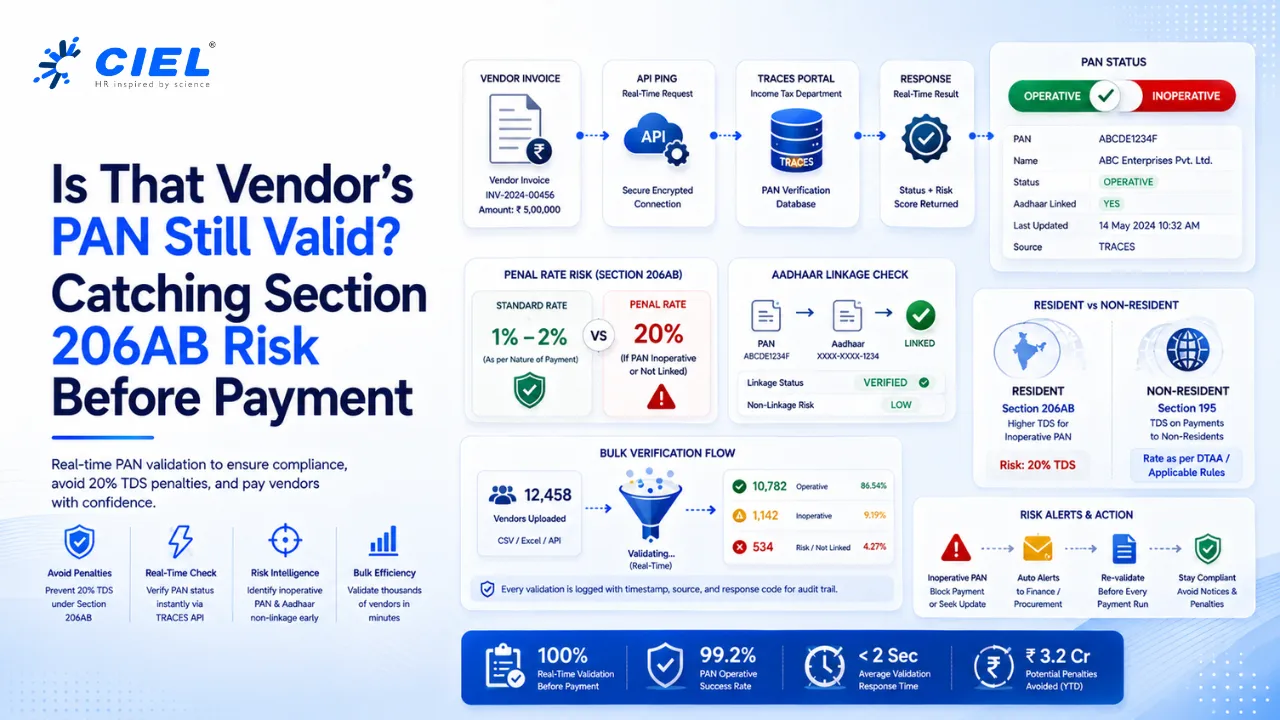
Automated PAN and TAN verification integrates TRACES portal APIs directly into financial workflows to validate vendor tax status before invoice processing. This mechanism identifies inoperative PANs and specified non-filers under Section 206AB, preventing organizations from absorbing 20% penal withholding rates and ensuring regulatory TDS compliance.
Why Do Manual PAN Verification Processes Fail During High-Volume Invoice Processing?
Finance teams evaluating TDS compliance workflows constantly ask how to identify inoperative vendor tax profiles before initiating payment runs. The core challenge lies in verifying thousands of vendor records against dynamic government databases without delaying the procurement cycle. Manual verification creates severe bottlenecks, forcing accounts payable teams to choose between processing delays and compliance risks. Missing a specified non-filer status triggers immediate financial liabilities for the deductor.
Why Does Traditional Tax Deduction at Source Evaluation Fall Short?
Traditional tax deduction at source evaluation relies on periodic manual checks using the Income Tax e-Filing portal. This static approach fails because vendor tax compliance statuses fluctuate based on their individual Aadhaar linkage and annual return filing behavior. When finance teams only verify PAN status during vendor onboarding, they miss subsequent compliance changes that occur before the actual payment date. This discrepancy results in incorrect withholding rates being applied during bulk processing.
What Are the Critical Criteria for Evaluating PAN and TAN Compliance Workflows?
An effective compliance framework utilizes API-driven validation to cross-reference vendor data against the TRACES portal in real-time. This mechanism ensures accurate TDS rate application by flagging high-risk vendors before the payment gateway executes the transaction. Organizations must evaluate their verification systems against strict operational thresholds.
- Section 206AB Validation: Verification latency > 24 hours = HIGH RISK. Latency < 1 hour = PASS. Action: Implement real-time API checks for specified non-filer status.
- Bulk Processing Capacity: Throughput < 500 records per minute = FAIL. Throughput > 1000 records per minute = PASS. Action: Utilize TRACES portal bulk verification utilities.
- Aadhaar Linkage Status: Inoperative PAN detection error rate > 1% = HIGH RISK. Action: Halt payments to vendors with inoperative PANs until the 48-hour reactivation window clears.
- Resident vs Non-Resident Rules: Non-resident tax profile misclassification > 0% = FAIL. Action: Apply Section 195 compliance rules strictly for non-resident vendor payments.
How Does Inoperative PAN Detection Impact Enterprise Accounts Payable?
Inoperative PAN detection prevents automated ERP systems from releasing payments at standard TDS rates when vendor tax profiles lack Aadhaar linkage. This mechanism protects the deducting organization from bearing the financial burden of the 20% mandatory withholding rate.
An enterprise accounts payable team at a national logistics firm sits mid-cycle through their month-end vendor payment run. Their existing ERP system relies on static vendor master data collected during initial procurement onboarding. The team assumes that because a transport vendor provided a valid PAN six months ago, the standard 1% or 2% TDS rate still applies to their pending 5 million INR invoice.
When the evaluation criteria lack real-time validation, the system completely misses that the vendor’s PAN became inoperative last week due to a missed Aadhaar linkage deadline. The finance team processes the payment at the standard rate, unknowingly creating a massive compliance gap. During the next quarterly TDS return filing, the TRACES portal flags the transaction, demanding the logistics firm pay the 20% penal rate out of their own pocket, along with associated interest and a 10,000 INR penalty for incorrect filing .
A correctly evaluated compliance workflow catches this discrepancy immediately. When the invoice enters the approval queue, the integrated validation engine pings the Income Tax e-Filing portal and immediately returns an “inoperative” status payload. The system automatically halts the payment, alerts the vendor relations manager to request compliance remediation, and recalculates the provisional withholding rate to 20%. Catching this single status change prevents the logistics firm from absorbing a 1 million INR tax liability.
How Do Modern TDS Compliance Systems Compare to Legacy Methods?
Modern TDS compliance systems automate tax profile validation through direct TRACES portal integration, replacing manual portal queries with programmatic JSON payloads. This approach eliminates human error in identifying specified non-filers and drastically reduces the time required to process month-end payments .
| Feature | Modern API-Driven Approach | Traditional Manual Approach |
|---|---|---|
| Bulk Verification | Processes 10,000+ PANs automatically via API | Requires manual CSV uploads and delayed downloads |
| Section 206AB Checks | Real-time flagging of specified non-filers | Periodic manual verification prone to timing errors |
| Inoperative PAN Handling | Halts payment automatically until reactivation | Relies on manual accounts payable holds |
| TAN Validation | Instant cross-reference against Income Tax e-Filing portal | Manual search per deductor record |
See how an automated API framework integrates with existing ERPs.
What Are the Trade-offs of Adopting Automated PAN Verification?
Automated PAN verification requires continuous API connectivity and strict data formatting alignment with government portal specifications. These technical prerequisites mean organizations must invest heavily in initial ERP integration before realizing any operational efficiency gains.
- Dependency on TRACES portal uptime and API responsiveness during peak tax filing seasons.
- Requires dedicated IT resources to manage API token renewals and handle encrypted JSON payloads securely.
- Does not automatically resolve vendor disputes regarding their Aadhaar linkage status or non-filer classification.
- Initial setup costs and integration timelines can exceed 3-4 months for complex legacy ERP environments.
How Can Organizations Implement a TDS Compliance Checklist?
A standardized TDS compliance checklist ensures accounts payable teams systematically verify both PAN and TAN records before executing bulk disbursements. This framework minimizes the risk of regulatory penalties by enforcing strict verification protocols across all vendor tiers. To ensure full compliance, finance teams must evaluate their current validation latency and upgrade to real-time verification engines.
Download the complete evaluation framework to audit your current TDS compliance workflow .
Frequently Asked Questions
What are the step-by-step instructions for bulk PAN verification on the TRACES portal?
To perform bulk PAN verification, authorized users must log into the TRACES portal, navigate to the ‘Dashboard’, and select ‘PAN Verification’. Users upload a formatted CSV file containing up to 10,000 PANs. The system processes the file and generates a downloadable report detailing the operative status and Section 206AB compliance for each record.
How do I check if a PAN is operative and what is the process to reactivate it if linked incorrectly with Aadhaar?
Finance teams can check PAN operative status via the Income Tax e-Filing portal under the ‘Verify Your PAN’ utility. If a PAN is inoperative due to incorrect Aadhaar linkage, the deductee must pay a 1,000 INR fee on the portal, submit a valid Aadhaar linking request, and wait up to 48 hours for the reactivation to propagate through the system.
What are the specific conditions that define a ‘specified non-filer’ under Section 206AB?
A specified non-filer under Section 206AB is a deductee who has not filed their income tax return for the previous relevant assessment year, and the aggregate of TDS and TCS in their case exceeds 50,000 INR in that year. This classification mandates deductors to withhold tax at twice the standard rate or 5%, whichever is higher.
What are the key differences in PAN verification rules for resident vs non-resident payments?
Resident PAN verification focuses on Aadhaar linkage and Section 206AB compliance to determine standard versus penal withholding rates. Non-resident payments fall under Section 195, where verification prioritizes Tax Residency Certificates (TRC) and Double Taxation Avoidance Agreement (DTAA) applicability, as non-residents are generally exempt from Aadhaar linkage requirements.
What are the technical prerequisites for integrating automated TRACES portal validation?
Integrating automated TRACES portal validation requires an ERP system capable of generating secure JSON payloads and handling REST API webhooks. Organizations must possess a valid TAN, register as a deductor on the portal, and secure authorized API credentials to establish the encrypted data connection.
What is the ROI timeframe for implementing an automated TDS compliance verification system?
Organizations typically achieve positive ROI within 4 to 6 months of implementing automated TDS compliance verification. This return is driven by the elimination of manual processing labor and the complete avoidance of 20% penal withholding rates and associated regulatory fines.
