

Table of Contents
A quarterly payroll compliance audit reconciles general ledger data against Form 941 filings, state tax records, and employee classification logs to identify discrepancies before regulatory deadlines. This process validates payroll software outputs against actual tax deposits and wage laws. Executing this audit every 90 days prevents compounding penalty fees, ensures accurate multi-state tax withholding, and maintains federal compliance across the organization.
How Does a Quarterly Payroll Compliance Audit Impact Organizational Risk?
A quarterly payroll compliance audit systematically compares internal payroll records against federal Form 941 filings and state tax submissions. This evaluation mechanism identifies unremitted liabilities and classification errors before they trigger regulatory penalties. Implementing this audit framework shifts an organization from assuming payroll accuracy to proving regulatory alignment.
Finance and human resources leaders constantly evaluate whether their current reconciliation process actually catches discrepancies or merely rubber-stamps payroll software outputs. The core evaluation centers on whether the organization relies on automated assumptions or active validation. When teams assess their risk exposure, the determining factor is the presence of an independent verification layer that audits the underlying data inputs rather than just reviewing the final payout totals.
Why Do Traditional Payroll Reconciliations Fail to Catch Compliance Gaps?
Traditional payroll reconciliations rely on surface-level matching between bank statements and gross pay totals without verifying underlying tax withholding rates or jurisdiction codes. This superficial verification masks deep-rooted compliance failures regarding exempt versus non-exempt classifications and multi-state tax liabilities . Relying solely on cash-outflow matching leaves organizations exposed to targeted state agency audits.
Teams assume that if the payroll software processes the run without error notifications, compliance is guaranteed. However, software only executes the operational rules configured within it. If an employee moves to a new state and the human resources information system (HRIS) is not updated, the software accurately calculates the wrong state taxes. Traditional reconciliations miss these structural errors because they do not question the origin of the data, focusing exclusively on whether the math adds up at the end of the month.
What Are the Key Steps to Audit Payroll Compliance Effectively?
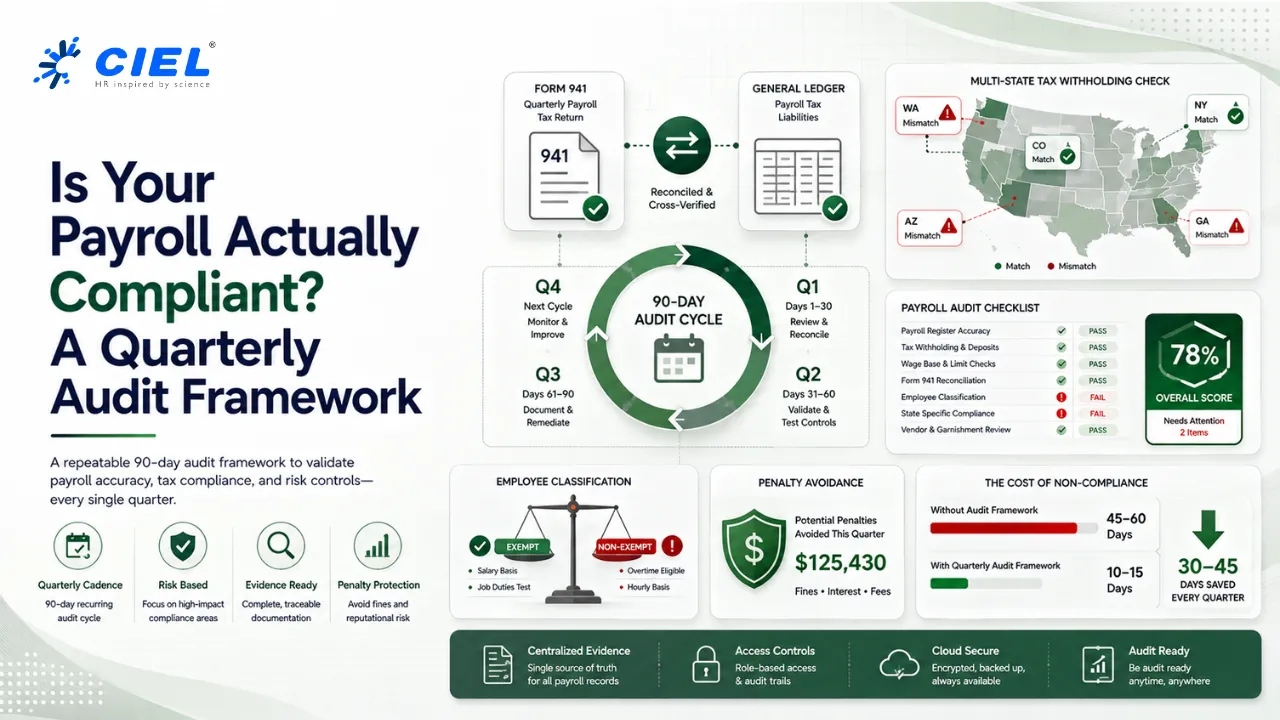
A comprehensive payroll audit framework establishes rigorous pass/fail thresholds for tax reconciliation, employee classification, and multi-state jurisdiction mapping. Applying this framework ensures that underlying data inputs match regulatory requirements, standardizing the audit process across all operational units. This structured approach removes subjective guesswork from the quarterly review cycle.
To execute this effectively, finance teams must apply explicit threshold logic to their evaluation checklist:
- Form 941 Variance: Discrepancy > $0.00 = FAIL. Action: Initiate immediate amended return protocol and trace the source of the unremitted liability.
- Exempt Classification Salary Threshold: Compensation < $43,888 annually = FAIL. Action: Reclassify the worker to non-exempt and audit historical timesheets for unpaid overtime.
- Multi-State W-4 Match: Alignment < 100% between resident state and tax withholding code = HIGH RISK. Action: Freeze jurisdiction changes until physical address verification is complete.
Step 1: Reconcile Form 941 with General Ledger Records
Extract the quarterly Form 941 summary from your payroll software and compare the total tax liabilities against the actual cash disbursements recorded in the general ledger. This is one of the most common errors to look for when reconciling Form 941 with payroll records. Any deviation indicates a failure in tax remittance.
Step 2: Verify Worker Classifications Across Jurisdictions
To verify employee classifications like exempt vs non-exempt during a payroll review, audit the salary logs of all employees against federal and state-specific minimum thresholds. Ensure that job duties align with the administrative, executive, or professional exemptions defined by the Fair Labor Standards Act.
Step 3: Validate Multi-State Tax Withholding
Run a jurisdiction variance report to match physical employee addresses with the state tax withholding codes applied in the payroll system. This step requires cross-referencing HRIS data with state-level reciprocity agreements to confirm accurate tax distribution.
How Does a Failed Audit Impact Multi-State Operations?
Multi-state payroll compliance requires precise alignment between an employee’s physical work location and the corresponding state tax withholding tables. Failing to validate this alignment during a quarterly review results in compounding tax liabilities across multiple jurisdictions. Uncorrected jurisdiction errors generate immediate penalty assessments from state revenue departments.
A mid-sized logistics company finalized its Q2 financial close, assuming their payroll platform had automatically handled tax distributions for their newly remote workforce. The finance director reviewed the high-level gross payroll reports, noted that total expenditures matched the general ledger, and signed off on the quarter. The evaluation criteria relied entirely on top-line budget alignment, assuming the software managed the granular jurisdiction rules.
During an end-of-year state tax review, the gap surfaced. Twelve dispatchers had relocated from Texas to Colorado and Illinois over the summer. The HR team updated their mailing addresses in the core system, but the payroll tax jurisdiction fields remained locked to Texas. Because the Q2 and Q3 audits only checked gross pay against bank withdrawals, no one verified the state-level withholding distribution. The company faced thousands of dollars in out-of-state penalties and was forced to issue amended W-2 filings.
The correct evaluation framework catches this immediately. By running a jurisdiction variance report alongside the quarterly Form 941 reconciliation, an auditor flags the mismatch between employee residency codes and state tax deductions. Instead of reacting to penalty notices in January, the finance team identifies the missing Colorado and Illinois withholdings in July. A structured audit transforms a latent compliance crisis into a routine mid-year adjustment.
How Do Active Audits Compare to Passive Payroll Reviews?
Active compliance auditing cross-references raw payroll data against external regulatory frameworks, whereas passive reviews merely confirm internal mathematical accuracy. Implementing active audits reduces regulatory penalty exposure by identifying classification and withholding errors before quarterly tax filings. This operational shift moves the organization from reactive correction to proactive validation.
| Feature | Active Compliance Audit | Passive Payroll Review |
|---|---|---|
| Form 941 Approach | Line-by-line reconciliation with general ledger | Assumes software output is correct |
| Worker Classification | Verifies FLSA salary thresholds dynamically | Accepts existing HRIS labels without question |
| Multi-State Tracking | Validates specific tax jurisdiction codes | Checks only total gross payroll expenditures |
| Error Resolution | Corrects discrepancies before filing deadlines | Reacts to agency penalty notices post-filing |
What Are the Trade-offs of Implementing a Rigorous Audit Framework?
Advanced audit frameworks demand significant administrative bandwidth and cross-departmental coordination between human resources and finance teams. These resource requirements often necessitate dedicated compliance personnel or specialized auditing software to manage the increased workload. Organizations must weigh the cost of this administrative overhead against the financial risk of non-compliance.
Considerations before implementation include:
- Not suitable when the organization lacks integrated HR and payroll systems, requiring entirely manual data extraction.
- Requires a dedicated investment of 20-40 hours per quarter from senior payroll staff.
- May delay the final quarterly financial close if discrepancies require extensive investigation and remediation.
Evaluate your current payroll compliance framework using a standardized audit checklist to identify hidden liabilities.
What Are the Next Steps After Finding Discrepancies in a Quarterly Payroll Audit?
Identifying discrepancies during an audit triggers a structured remediation protocol that includes filing amended tax returns, adjusting future withholdings, and updating internal system configurations. Executing these corrective actions promptly prevents the accumulation of penalties and interest from tax authorities. Immediate documentation of the corrective steps is required to demonstrate good faith compliance efforts.
Knowing what documentation is required for a complete quarterly payroll audit trail ensures that the organization can defend its remediation steps. Teams must archive the original erroneous report, the manual calculation proving the error, the general ledger adjustment entry, and the confirmation receipt for any amended Form 941 filings. Furthermore, understanding how to use payroll software reports to simplify a quarterly compliance check allows teams to automate the extraction of these audit trail documents.
Establish a recurring calendar event for the audit process and assign specific validation tasks to your finance and HR teams before the next quarter ends.
Frequently Asked Questions
How do payroll software systems integrate with general ledger platforms for compliance auditing?
Payroll platforms use API connections or flat-file exports to push mapped journal entries directly into the general ledger. This integration ensures that total tax liabilities calculated by the payroll engine match the actual cash disbursements recorded in the accounting system.
What is the financial ROI of conducting quarterly payroll compliance audits?
The return on investment is measured entirely in penalty avoidance. Identifying a single multi-state jurisdiction error or unremitted Form 941 liability before the quarterly deadline saves organizations an average of 5% to 15% in compounding interest and failure-to-deposit penalties.
How does an audit mechanism verify exempt versus non-exempt employee classifications?
The audit mechanism extracts employee salary data and cross-references it against the federal threshold of $43,888 annually. It flags any employee categorized as exempt who falls below this compensation level, triggering a mandatory reclassification review.
What documentation is required to maintain a complete payroll audit trail?
A complete audit trail requires archived copies of Form 941, state unemployment insurance filings, general ledger disbursement records, and jurisdiction variance reports. These documents must be date-stamped and retained for a minimum of four years.
What are the key challenges of auditing payroll with remote employees in multiple states?
The primary challenge is maintaining perfect synchronization between an employee’s physical work address and the corresponding state tax withholding tables. Failure to update jurisdiction codes when an employee relocates results in immediate tax remittance failures.
What are the most common errors to look for when reconciling Form 941?
Auditors primarily look for discrepancies between total reported wages and actual bank disbursements, miscalculated Social Security and Medicare fractions, and failures to report third-party sick pay accurately on the quarterly return.
