

Table of Contents
The most frequent errors in TDS return filing stem from manual data entry, incorrect rate application, and PAN mismatches. TDS compliance software cross-references vendor master data against real-time regulatory databases to apply exact withholding rates. This mechanism eliminates short deduction penalties and ensures ledger reconciliation matches Form 26AS perfectly, reducing compliance overhead and preventing costly statutory notices.
What Causes Persistent TDS Compliance Failures?
Corporate finance teams routinely face statutory notices and financial penalties despite having dedicated accounting staff. The core business problem is that tax deduction at source is treated as a periodic reporting task rather than a continuous transactional validation. When organizations process thousands of vendor payments, the sheer volume of data creates a high probability of human error, leading to non-compliance, reputational damage, and unexpected financial liabilities.
This problem persists because traditional finance workflows rely on retrospective reconciliation rather than proactive validation. Accounting systems record a transaction first and verify the tax logic weeks later during the quarterly return preparation. By the time a mismatch between the deducted amount and the statutory requirement is discovered, the payment has already cleared, leaving the organization liable for shortfalls, interest, and late fees.
TDS compliance software validates vendor tax identification numbers and applicable withholding rates at the point of invoice processing. This prevents the most frequent errors in TDS return filing by ensuring the deduction matches the exact regulatory requirement before the payment executes.
How Do Automated TDS Systems Prevent Errors?
Modern compliance frameworks integrate directly with enterprise resource planning software to execute real-time syntax validation.
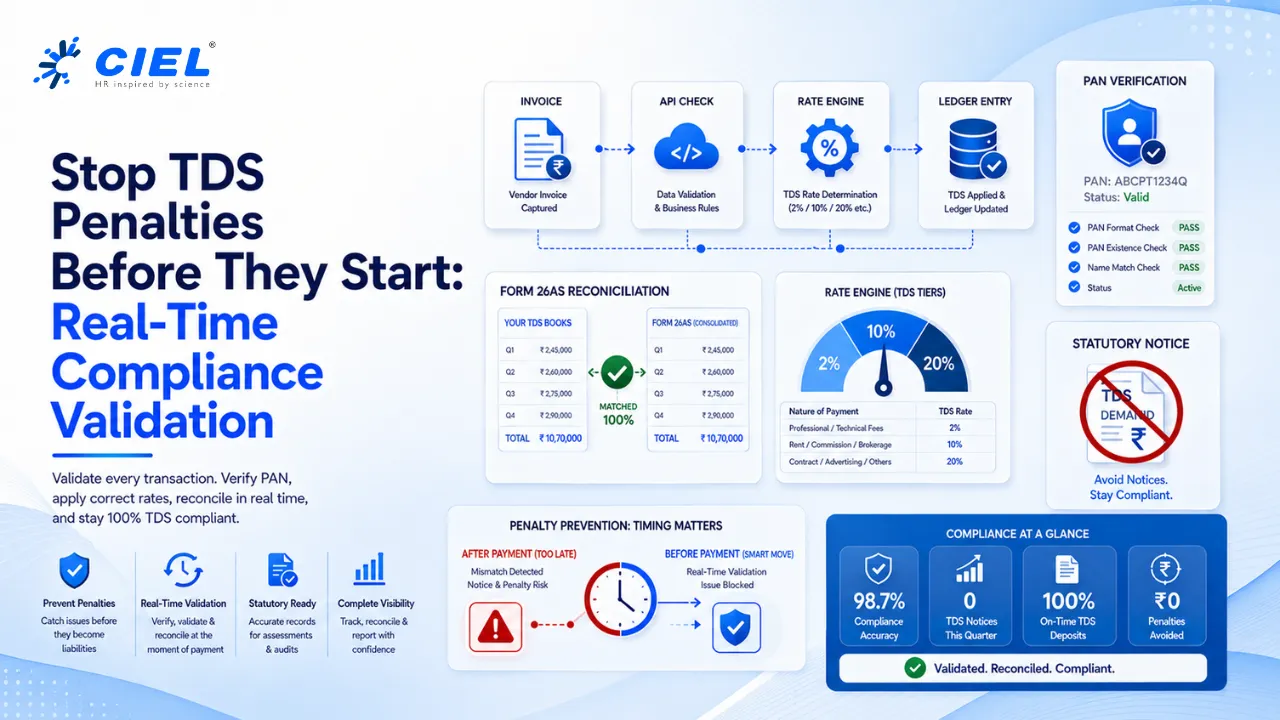
TDS compliance software connects corporate payment gateways to a centralized tax rule engine via API, calculating exact withholding amounts before invoice approval. This mechanism eliminates the risk of applying incorrect TDS rates for different payment types, generating an accurate audit trail that prevents statutory penalties.
By checking the vendor database instantaneously, the system maps out the consequences of late TDS payment and how to calculate the penalty for historical anomalies while preventing new ones. The API processes these checks in under 200 milliseconds, ensuring that the accounts payable workflow remains uninterrupted. Finance teams rely on this automated rule engine to apply the correct 2% or 10% rate based on the precise nature of the contract.
What Does a TDS Compliance Failure Look Like in Practice?
TDS compliance software intercepts ledger entries during the approval stage, cross-referencing vendor credentials against statutory databases. This mechanism halts incorrect disbursements immediately, preventing downstream reporting failures.
A finance operations team at a regional manufacturing hub processes quarterly vendor payouts on the final Friday of the month. The accounts payable clerk receives an invoice for technical consulting services and manually selects a standard 10% deduction rate based on previous billing cycles. The vendor’s PAN status recently changed in the statutory database, requiring a higher deduction rate, but the internal vendor master data remains un-updated. The payment clears, and the quarter closes without any immediate red flags.
Three months later, the finance director receives a statutory notice indicating a short deduction of TDS . The discrepancy triggers an automatic penalty calculation, compounding a 1.5% monthly interest rate on the deficit alongside a flat Section 234E daily late fee of ₹200. The team drops their current monthly closing tasks to dig through hundreds of ledger entries, attempting to locate the specific transaction that triggered the mismatch. They spend three days cross-referencing internal records against the government portal, losing valuable operational time to retrospective auditing.
The same scene under an active system plays out differently. When the clerk inputs the invoice, TDS compliance software pings the central tax database via API before allowing the payment to proceed. The software flags the PAN status change instantly, blocks the 10% deduction, and automatically adjusts the withholding rate to 20% in the ledger. The payment executes correctly on the first attempt. The compliance gap never materializes.
What Are the Trade-offs of Implementing Automated Compliance?
Deploying an automated tax validation system requires specific operational adjustments and infrastructure readiness.
TDS compliance software enforces strict data structures that reject non-standard vendor information during the onboarding phase. This forces procurement teams to gather complete tax documentation upfront, which extends initial vendor setup times by 24 to 48 hours but eliminates downstream reporting failures.
Considerations before implementation:
- Not suitable when the organization processes fewer than 50 invoices annually, as the API integration cost outweighs the penalty risk.
- Requires continuous internet connectivity to validate tax identification numbers against government portals in real-time.
- Demands strict internal data governance, as the system will block any payment lacking a verified PAN.
How Do Traditional and Modern TDS Approaches Compare?
Evaluating tax deduction strategies requires comparing manual reconciliation against real-time validation frameworks.
TDS compliance software evaluates transaction data against statutory rules at the moment of creation. This prevents penalties for non-deduction or short deduction of TDS by ensuring every ledger entry matches the exact legal requirement prior to fund disbursement.
| Feature | Real-Time Validation | Traditional Reconciliation |
|---|---|---|
| Error Detection | Pre-payment API check | Post-payment quarterly audit |
| Rate Application | Dynamic rule engine | Manual ledger selection |
| Mismatch Resolution | Instant system block | Retrospective manual search |
| Penalty Risk | Near zero | High due to human error |
What Are the Thresholds for TDS Compliance Audits?
Establishing a structured internal audit framework requires defined pass/fail metrics for vendor data.
TDS compliance software scores every transaction against predefined compliance parameters before authorizing the final ledger entry. This establishes best practices for maintaining accurate TDS records to prevent compliance issues by rejecting any invoice that fails the structural validation threshold.
Threshold Logic for TDS Compliance:
- Vendor PAN Validation: Match rate < 100% = HIGH RISK (Block payment). Match rate = 100% = PASS (Proceed).
- Rate Accuracy Check: Applied rate vs Statutory rate variance > 0% = FAILURE. Action: Reroute to tax manager.
- Form 26AS Reconciliation: Ledger mismatch > ₹100 = INVESTIGATE. Initiate steps to take when there is a mismatch between Form 26AS and my financial records within 48 hours.
- Certificate Generation: Delay > 15 days from filing = PENALTY RISK. Resolve common mistakes found in TDS certificates and how to correct them immediately.
Explore how automated tax frameworks streamline financial operations and protect your bottom line.
Frequently Asked Questions
How does TDS compliance software integrate with existing ERP systems?
TDS compliance software utilizes RESTful APIs to connect directly with enterprise resource planning systems . The software intercepts the invoice data during the accounts payable workflow, validates the tax identification numbers, and returns the correct withholding rate to the ledger before the payment clears.
What is the typical ROI timeframe for implementing tax deduction automation?
Organizations achieve full return on investment within six to nine months. The savings generate directly from the elimination of Section 234E late fees, the reduction of 1.5% monthly interest on short deductions, and the recovery of hundreds of hours previously spent on manual reconciliation.
How do real-time validation engines calculate the exact withholding amount?
The validation engine extracts the transaction metadata, including the payment nature and vendor classification. It cross-references these variables against a continuously updated statutory database to determine the precise percentage required, applying the exact deduction to the ledger automatically.
What happens if the government portal experiences downtime during a transaction?
If the statutory database is unreachable, the system relies on a cached local rule engine updated daily. The transaction proceeds using the most recent verified data, and the system flags the entry for an automatic background re-validation once the external API connection restores.
How does TDS compliance software handle mismatches in Form 26AS?
TDS compliance software continuously parses government portal data and compares it against internal ledgers line by line. If a discrepancy occurs, the platform isolates the specific transaction ID, alerting the finance team to file a correction statement before the discrepancy triggers a formal statutory notice.
What are the penalties for non-deduction or short deduction of TDS?
Failing to deduct the correct tax amount results in severe financial liabilities. Organizations face a mandatory interest charge of 1% to 1.5% per month on the shortfall, alongside potential disallowance of the expense under Section 40(a)(ia), which inflates the overall corporate tax burden.
