
Table of Contents
Beyond Recruitment: Why RPO Is Becoming a Strategic Workforce Solution
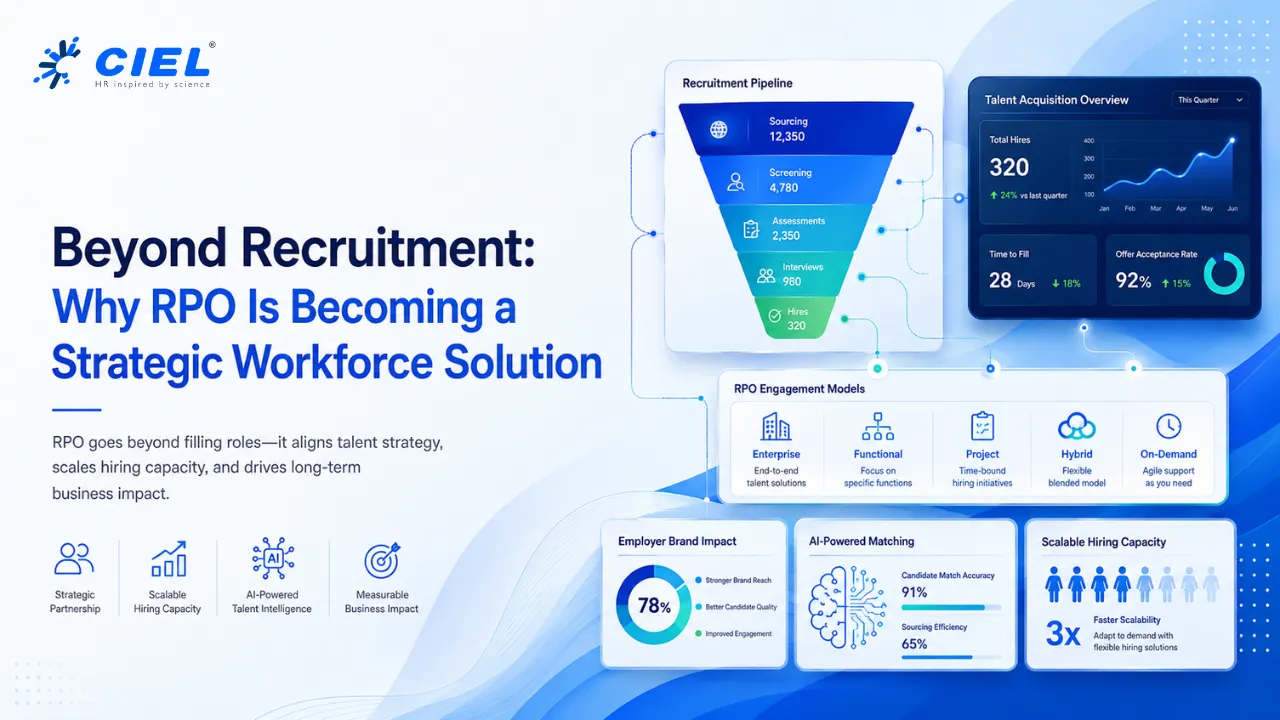
Recruitment Process Outsourcing (RPO) is a workforce solution in which an organisation partners with an external provider to manage some or all of its recruitment function, from workforce planning and sourcing to candidate experience and hiring analytics. For years, RPO was viewed through a narrower lens: a way to fill open positions faster and more efficiently. Hand over the job requisitions, get back a shortlist, and move on. That transactional view of RPO is fading. Today, forward looking organisations are treating RPO not simply as a hiring vendor, but as a strategic partner integrated into their broader workforce planning and talent strategy.
The shift isn’t cosmetic. It reflects a deeper change in how businesses think about talent, as a driver of competitive advantage and business growth rather than simply a cost centre to be managed. As organisations navigate changing skill requirements, evolving business models, and greater workforce complexity, the ability to access the right talent at the right time has become increasingly strategic.
The Old Model Is Running Out of Road
Traditional RPO was built for a predictable world: steady hiring volumes, stable job descriptions, easily accessible talent pools. That world has changed. Skill requirements are shifting fast, especially in technology, engineering, and digital roles, while economic uncertainty, hybrid workforces, and rising candidate expectations add further pressure.
Organisations now need a hiring function that can flex with demand, anticipate talent needs, and use data to inform decisions, not just fill vacancies as they arise.
Transactional RPO vs Strategic RPO
| Dimension | Transactional RPO | Strategic RPO |
| Starting point | Begins when a requisition is raised | Begins with workforce planning ahead of demand |
| Focus | Filling open roles | Anticipating and building talent pipelines |
| Measurement | Time to fill, cost per hire | Time to fill, quality of hire, pipeline health, source effectiveness, hiring velocity |
| Candidate experience | Managed on a role by role basis | Consistent employer brand experience across every touchpoint |
| Technology use | Applicant tracking and basic automation | AI enabled sourcing, matching, and predictive analytics |
| Engagement Model | Fixed scope, fixed volume | Scalable, flexes with business priorities |
| Relationship | Vendor | Extension of the Talent Acquisition function |
What “Strategic RPO” Actually Looks Like
The evolution from transactional to strategic RPO shows up in several concrete ways.
1. Workforce planning, not just requisition fulfilment
Strategic RPO partners align recruitment capacity with business priorities ahead of time, whether that means a new market, a scaling business unit, or a new capability.
2. Data and analytics at the core
Metrics like time to fill, source effectiveness, pipeline health, and cost per hire are tracked continuously and turned into workforce intelligence, not just recruitment reporting.
3. Employer branding as a shared responsibility
Since RPO teams are often a candidate’s first touchpoint, strategic partners help protect a consistent, on brand candidate experience across every interaction.
4. Technology and AI enabled recruitment
AI sourcing, candidate matching, and automation boost productivity, but the real value comes from combining technology with recruiter expertise and market knowledge.
5. Scalable and flexible engagement models
Recruitment capacity flexes with the business through enterprise wide, function based, project based, hybrid, or on demand RPO models, rather than one fixed structure.
Common RPO Engagement Models
| Model | Best suited for |
| Enterprise wide RPO | Organisations wanting a fully outsourced, end to end recruitment function across roles and locations |
| Function based RPO | Businesses that need dedicated support for a specific function, such as technology or sales hiring |
| Project based RPO | Time bound needs like a new market launch, a large expansion, or a seasonal hiring spike |
| Hybrid RPO | Organisations that want to retain control of certain hiring while outsourcing sourcing, screening, or other specific stages |
| On demand RPO | Businesses with fluctuating hiring volumes that need capacity to flex up or down quickly |
Why the Shift Is Accelerating Now
Demand for specialised and emerging skills is making talent access a business priority, especially as companies invest in technology and digital transformation. At the same time, businesses want recruitment efficiency without sacrificing quality or candidate experience, and a strategic RPO model helps standardise processes and improve visibility into performance.
Multi location operations add further complexity, requiring consistent processes alongside flexibility for local talent markets. But the biggest driver is workforce agility: business needs change quickly, and a recruitment function built around fixed volumes struggles to keep pace. RPO provides the flexibility to match hiring to real time business needs.
The Business Case for Strategic RPO
The right question isn’t “how quickly can you fill this role?” It’s:
- Can this partner anticipate talent needs rather than just respond to openings?
- Do they bring real insight into talent availability and market dynamics?
- Can they handle both high volume and specialised, hard to fill hiring?
- Will they protect a consistent candidate experience at scale?
- Do they integrate technology, analytics, and human expertise well?
- Can their model scale as our business changes?
A partner who answers yes to these becomes an extension of the Talent Acquisition function, not just a staffing vendor.
From Recruitment Partner to Workforce Partner
Recruitment is increasingly tied to business growth, skills strategy, and organisational agility. Strategic RPO brings together recruitment expertise, technology, process discipline, and market intelligence to help organisations build a more responsive talent acquisition function, one that augments internal teams rather than replacing them.
The organisations that build a lasting talent advantage won’t necessarily have the biggest internal recruiting teams. They will be the ones with the right combination of people, technology, data, and partnerships to keep pace with changing talent needs.
Frequently Asked Questions
What is RPO in simple terms?
RPO, or Recruitment Process Outsourcing, is when a company hands over part or all of its hiring process to an external specialist provider, who then acts as an extension of the internal HR or Talent Acquisition team.
How is strategic RPO different from traditional RPO?
Traditional RPO focuses on filling individual roles as they come up. Strategic RPO focuses on workforce planning, talent pipelines, analytics, and employer branding, so hiring is planned ahead of business needs rather than reacting to it.
What are the main types of RPO engagement models?
The most common models are enterprise wide RPO, function based RPO, project based RPO, hybrid RPO, and on demand RPO. Each suits a different combination of hiring volume, role specialisation, and business timeline.
What industries benefit most from RPO?
RPO is widely used across technology, manufacturing, healthcare, BFSI, and telecom, particularly by organisations facing high volume hiring, skill shortages, or multi location recruitment needs.
Does RPO replace an internal HR or Talent Acquisition team?
No. RPO is designed to augment an internal team’s capacity and capability, not replace it. Most strategic RPO engagements work alongside internal HR and Talent Acquisition functions.
How do companies measure RPO success?
Common metrics include time to fill, quality of hire, cost per hire, source effectiveness, pipeline health, and candidate experience scores, tracked continuously rather than reviewed only at the end of a hiring cycle.
Explore Strategic RPO with CIEL HR
At CIEL HR, we see RPO as more than an outsourced recruitment function. We see it as an opportunity to strengthen an organisation’s Talent Acquisition capability through specialised expertise, scalable recruitment solutions, technology, and market intelligence.
Whether the requirement is to scale hiring, access specialised talent, or build a more agile recruitment function, the right RPO model can help organisations align talent acquisition more closely with business priorities.
Ready to rethink what RPO can do for your organisation? Connect with the CIEL HR team to explore an RPO approach aligned with your business needs.
