

Table of Contents
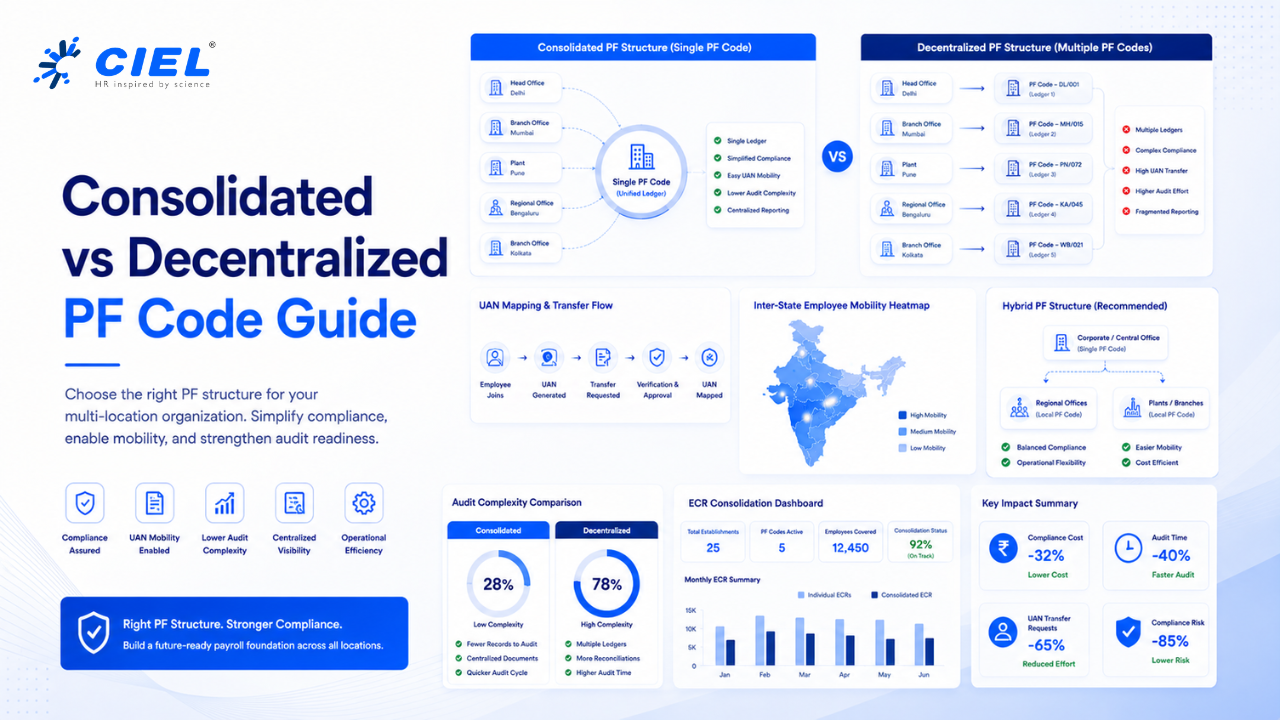
The choice between a consolidated and decentralized Provident Fund (PF) code for multi-location establishments depends directly on workforce mobility and audit infrastructure. A consolidated PF code centralizes compliance and remittance under a single ledger, reducing administrative overhead for highly mobile workforces. Conversely, decentralized PF codes isolate state-level liabilities, which benefits organizations with autonomous regional payroll systems. The correct structure aligns the administrative burden with the organization’s capacity for centralized financial control.
What Determines the Right PF Code Structure?
Multi-location establishments evaluate PF code structures by analyzing employee transfer rates and payroll centralization capabilities. This assessment determines whether a single registration or state-specific codes will minimize compliance risks.
A consolidated PF code centralizes monthly statutory remittances into a unified ledger, reducing audit reconciliation times by up to 40% for organizations with high inter-state employee mobility. When organizations expand across state lines, human resources and finance leaders must decide how to manage statutory liabilities. Evaluating this choice requires looking beyond immediate registration convenience. The evaluation centers on whether the business operates as one cohesive entity moving talent freely, or as a collection of independent regional silos managing their own localized workforces.
Why Do Common PF Code Evaluations Fall Short?
Standard PF code evaluations often fail because they prioritize immediate registration convenience over long-term employee lifecycle management . This oversight creates severe data fragmentation when personnel transfer across regional branches.
Many organizations evaluate their structure based entirely on the initial setup process. They assume that allowing a new branch to register its own local PF code is the path of least resistance. This evaluation ignores the long-term cost implications of maintaining separate PF codes for each location. Over time, the administrative debt compounds. Every new state requires a new login, a new monthly filing, and a separate audit trail. When the evaluation focuses only on day-one deployment, it completely misses the operational friction generated during month-end reconciliation and annual statutory assessments.
What Criteria Separate Effective PF Structures From Inefficient Ones?
An effective PF structure framework evaluates regional autonomy against central reporting requirements using specific mobility thresholds. Applying these criteria prevents compliance bottlenecks during annual statutory audits.
To determine the correct architecture, finance and HR teams must apply strict threshold logic to their operational data. Relying on subjective preferences leads to fragmented systems. Use the following operational authority block to dictate the structural decision:
- Inter-State Transfer Rate: Annual mobility > 15% = HIGH RISK for decentralized codes. Action: Consolidate to a single employer ledger to eliminate UAN transfer friction.
- Payroll Autonomy Level: Regional branches process 100% of payroll independently = PASS for decentralized codes. Action: Maintain separate codes to isolate regional liability.
- Compliance Budget Threshold: Annual reconciliation budget < $50,000 = HIGH RISK for decentralized codes. Action: Consolidate to reduce external auditor billable hours.
- HRIS Centralization: Unified cloud payroll system deployed = PASS for consolidated code. Action: Leverage the HRIS to generate a single monthly electronic challan cum return (ECR).
How Does PF Structure Impact Operational Reality?
Operational reality testing exposes the friction points between HR policy and statutory compliance mechanisms . Simulating an employee transfer under different PF structures reveals the exact administrative cost of fragmented data.
A regional finance operations team at a growing retail chain sits down to reconcile the quarterly statutory audit across 42 store locations. They operate under a decentralized Provident Fund structure, evaluating the system based purely on localized payroll autonomy. The assumption was that local store managers could handle their own compliance filings faster than a central corporate office.
The evaluation missed the reality of retail management mobility. During the quarter, twelve store managers transferred across state lines to open new branches. Because the evaluation criteria ignored inter-state transfer friction, the system requires each manager to manually transfer their PF accumulations from the origin state code to the destination state code. The regional finance team spends three weeks chasing missing Universal Account Number (UAN) mapping approvals and correcting localized ledger discrepancies.
A correctly evaluated consolidated PF structure catches this exact mobility pattern during the procurement phase. A transferring manager simply changes their physical location tag while their UAN remains mapped to the exact same employer ledger. The compliance team runs one unified monthly remittance file that takes two hours to validate. Decentralized systems optimize for local control, but consolidated systems optimize for workforce velocity.
How Do Consolidated and Decentralized PF Codes Compare?
A structural comparison highlights the mechanical differences between unified and fragmented compliance architectures. This side-by-side analysis dictates the operational resource allocation required for each approach.
| Feature | Consolidated PF Code | Decentralized PF Codes |
|---|---|---|
| Remittance Processing | Single monthly ECR file uploaded centrally | Multiple localized ECR files uploaded by region |
| Employee Transfers | Zero administrative friction; UAN remains mapped | Requires manual UAN transfer requests and approvals |
| Audit Complexity | Centralized, single point of review | Fragmented across regional offices and ledgers |
| Scalability for Retail | High (Add locations without new registrations) | Low (Requires new statutory registration per state) |
To see how a unified ledger reduces audit complexity, explore our compliance architecture framework .
What Are the Trade-offs of a Decentralized PF Approach?
Decentralized PF architectures isolate regional financial liabilities but introduce severe data reconciliation challenges. These trade-offs manifest as increased labor costs during annual statutory audits.
A decentralized approach is not suitable when:
- Inter-state employee mobility exceeds 10% annually, creating a backlog of unapproved transfer claims.
- The organization lacks dedicated regional compliance officers to manage localized monthly remittances .
- Centralized payroll processing software is already deployed, making localized filings redundant.
- The business plans aggressive expansion into new states, which would require constant new establishment registrations.
How Can a Company Implement a Hybrid PF Structure?
A hybrid PF structure segments the workforce by mobility profile, assigning corporate staff to a consolidated ledger while keeping localized workers on decentralized codes. This dual-architecture approach balances central reporting with local branch autonomy.
Organizations that cannot fully commit to a single model deploy a hybrid framework. In this setup, highly mobile roles—such as regional managers, corporate executives, and implementation teams—are registered under a single master PF code. Meanwhile, stationary facility workers remain on state-specific codes managed by local plant HR. This ensures that the employees most likely to trigger inter-state transfer paperwork are shielded from the administrative friction, while the bulk of the localized workforce remains under regional liability control. Implementing this requires an HRIS capable of routing employees to different ECR generation batches based on their role classification.
Ready to streamline your statutory compliance? Evaluate your current PF structure with our audit assessment tool .
Frequently Asked Questions
What technical prerequisites exist for migrating to a consolidated PF code?
Migrating to a consolidated PF code requires a centralized human resources information system (HRIS) capable of generating a unified electronic challan cum return (ECR) file. The organization must also complete the KYC linkage for all active Universal Account Numbers (UAN) before initiating the ledger merge.
What is the typical ROI timeframe for centralizing PF compliance?
Organizations typically realize a positive return on investment within 6 to 9 months. The financial return stems from eliminating redundant regional compliance officer salaries and reducing the billable hours required by external auditors to reconcile fragmented state-level ledgers.
How does a consolidated PF code process employee transfers mechanically?
A consolidated PF code processes internal transfers by updating the physical location tag within the central payroll database. The employee’s UAN remains mapped to the exact same employer establishment ID, requiring zero statutory transfer forms or external approval workflows.
What factors determine if a business should use a single vs multiple PF codes for its branches?
The primary determining factors are annual inter-state employee mobility rates and the centralization level of the payroll infrastructure. Businesses with high mobility and centralized payroll benefit from a single code, while highly autonomous regional entities operate better under multiple codes.
What are the specific operational challenges when managing multiple decentralized PF codes?
Managing multiple decentralized PF codes creates severe data fragmentation during audits. HR teams face missing UAN mapping approvals, delayed localized ledger reconciliations, and increased administrative friction whenever an employee transfers across state lines.
How does a consolidated PF code simplify compliance and audits for a company with offices in multiple states?
A consolidated PF code simplifies audits by merging all state-level liabilities into a single monthly remittance file. Auditors review one centralized ledger instead of cross-referencing dozens of regional filings, drastically reducing the time required to validate statutory compliance.
