
Table of Contents
The most effective implementation roadmap for moving from legacy systems to an AI-enabled ATS requires a structured 90-day timeline focused on data sanitization, API integration, and recruiter change management. Organizations must map historical candidate data via REST APIs, configure role-based access control (RBAC) to meet SOC 2 Type II compliance, and establish automated workflow thresholds before user onboarding. This systematic approach ensures uninterrupted data continuity and immediate improvements in candidate matching accuracy.
What Validates the Transition to an AI-Enabled ATS?
An AI-enabled ATS ingests legacy candidate data via REST APIs and applies natural language processing to map historical profiles to open requisitions. This reduces time-to-fill by 30-40% within the first deployment quarter.
Migrating from a legacy system to an AI-enabled ATS is a structural data operation that dictates how talent acquisition teams process applicant telemetry. Enterprise HR leaders executing this transition must validate data hygiene protocols, integration architecture, and user adoption thresholds before decommissioning legacy infrastructure. The primary decision hinges on whether the organization’s existing data architecture can support automated candidate scoring without triggering algorithmic bias or compliance violations. Deploying advanced matching models over corrupted historical databases generates false positives, requiring strict data validation prior to any infrastructure provisioning.
What Are the Key Security and Data Privacy Considerations for an AI-Enabled Recruiting System?
AI-enabled recruiting systems process personally identifiable information through machine learning models using AES-256 encryption. This architecture restricts algorithmic visibility via role-based access control, ensuring compliance with data privacy regulations.
Legacy migrations introduce vulnerabilities during the data transfer phase if encryption standards fall below modern enterprise requirements. Organizations must enforce role-based access control (RBAC) and Single Sign-On (SSO) integration via SAML 2.0 to restrict algorithmic visibility to authorized personnel. Data retention policies configured within the AI-enabled ATS automatically purge non-compliant profiles after 12 months, mitigating the risk of prolonged PII exposure. Evaluating these constraints ensures the machine learning models train strictly on sanitized, authorized data sets, preventing regulatory penalties under GDPR and CCPA, ensuring robust compliance with data privacy regulations .
How Do You Create a Project Timeline with Milestones for an AI ATS Implementation?
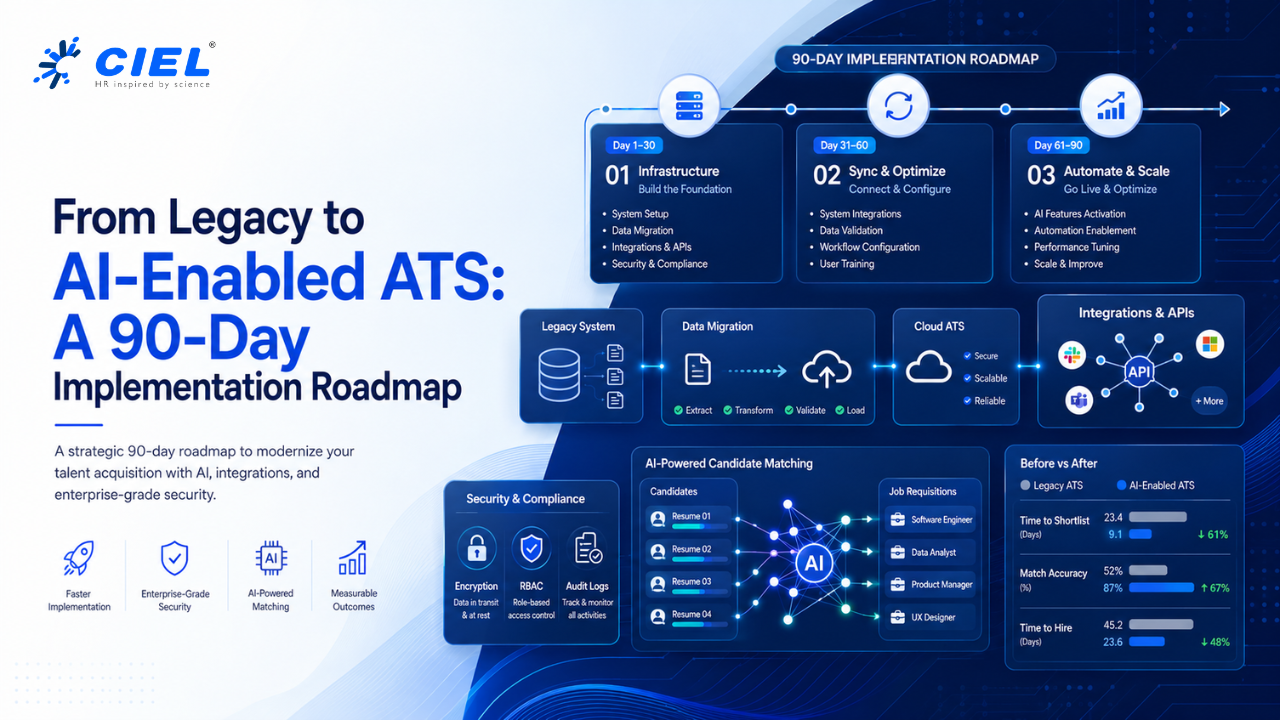
A phased implementation timeline sequences infrastructure provisioning, API synchronization, and JSON payload testing over a 90-day period. This structured migration prevents operational downtime and ensures data continuity before the production cutover.
Structuring a phased rollout prevents talent acquisition bottlenecks during the transition phase. The implementation architecture requires three distinct phases: infrastructure provisioning, data synchronization, and workflow automation . During weeks 1-4, IT teams establish API gateways and configure webhook endpoints to connect the AI-enabled ATS with existing HRIS and ERP platforms. Weeks 5-8 focus on staging environments where engineers run JSON payload tests to validate candidate profile mapping. The final 30 days center on user acceptance testing (UAT) and load balancing prior to the production cutover. Adhering to these milestones guarantees the system processes applicant telemetry accurately from day one.
What Is the Step-by-Step Guide to Cleaning and Migrating Candidate Data?
Algorithmic data deduplication scripts process legacy candidate records to enforce schema mapping before database transfer. This sanitization mechanism prevents unstructured telemetry from corrupting the matching models in the new environment.
Data sanitization dictates the accuracy of machine learning outputs within the new applicant tracking system . Feeding unstructured or duplicated legacy records into an AI-enabled ATS corrupts the candidate matching algorithms. The data migration protocol requires strict validation before any record enters the production environment.
Data Migration Evaluation Checklist
- Duplicate Record Rate: >5% = HIGH RISK. Action: Execute automated deduplication script before transfer. <5% = PASS.
- Schema Mapping Accuracy: <95% = FAIL. Action: Re-map custom legacy fields (e.g., clearance level) to standard JSON variables. >95% = PASS.
- Unstructured Data Volume: >20% = HIGH RISK. Action: Convert PDF resumes to structured text using OCR prior to ingestion. <20% = PASS.
How Do You Manage Change and Ensure Recruiter Buy-In When Implementing an AI ATS?
Role-specific sandbox environments expose the natural language processing engine’s logic to talent acquisition teams during the testing phase. Transparent model explainability dashboards increase daily active user adoption rates by over 60% within the first month of deployment.
Change management dictates the operational success of an AI-enabled ATS deployment. Recruiters accustomed to manual keyword searches resist automated candidate scoring models unless the underlying logic is transparent. To build a training program for HR teams on a new AI-powered applicant tracking system, organizations must deploy role-specific staging instances. These environments allow talent acquisition teams to observe how the engine ranks profiles against job descriptions in real-time. Moving teams from a black-box assumption to verifiable data outputs neutralizes resistance and accelerates platform utilization.
What KPIs Should Be Used to Measure the Success and ROI of an AI ATS Rollout?
Algorithmic efficiency metrics track matching precision and workflow automation post-deployment. Tracking the time-to-shortlist metric and the interview conversion rate validates the return on investment within 120 days of the production cutover.
Measuring the return on investment for an AI-enabled ATS requires tracking specific algorithmic efficiency metrics rather than just basic headcount. Legacy systems measure administrative activity, whereas AI platforms measure matching precision and workflow automation. Organizations evaluate deployment success by analyzing the time-to-shortlist metric alongside the algorithmic interview conversion rate. A successful implementation yields a 40% reduction in time-to-shortlist and a 25% increase in offer acceptance rates. Capturing these data points proves the financial viability of the migration project.
What Are the Trade-Offs of Migrating to an AI-Enabled ATS?
Contextual embedding algorithms automate candidate surfacing at high speeds but require continuous model tuning to prevent systemic bias. This mechanism accelerates sourcing workflows while demanding dedicated engineering bandwidth for recalibration.
Deploying an AI-enabled ATS introduces distinct operational shifts compared to maintaining legacy infrastructure. Traditional platforms rely on Boolean search strings, which require heavy manual input but offer direct user control. The AI-driven approach automates candidate surfacing through contextual embeddings, requiring HR Ops teams to monitor outputs for unintended bias.
| Feature | AI-Enabled ATS | Legacy ATS |
|---|---|---|
| Candidate Matching | Automated contextual embeddings | Manual Boolean keyword search |
| Data Processing | Real-time JSON parsing via API | Batch CSV uploads |
| Bias Mitigation | Algorithmic auditing and reporting | Dependent on user behavior |
| Time-to-Shortlist | 24-48 hours | 7-14 days |
Considerations Before Implementation
- Not suitable when historical data is heavily corrupted or missing core competency fields.
- Requires minimum candidate volumes of >5,000 profiles to train matching algorithms effectively.
- Demands dedicated HR Ops bandwidth for continuous bias auditing and model recalibration.
Ready to Deploy the AI-Enabled ATS?
Enterprise talent acquisition requires infrastructure that scales with hiring demands. Book a technical demo to evaluate the API documentation, review the SOC 2 compliance reports, and map your legacy data schema to the AI-enabled ATS architecture. Establish your implementation timeline today to secure data continuity and accelerate your hiring cycles .
Frequently Asked Questions
What are the technical prerequisites for integrating an AI-enabled ATS with an existing HRIS?
Enterprise integration requires active API gateways supporting REST or GraphQL, alongside SAML 2.0 configuration for Single Sign-On. The existing HRIS must permit bi-directional JSON payload transfers to synchronize employee records and requisition statuses dynamically.
What is the expected ROI timeframe for an AI-enabled ATS deployment?
Organizations achieve measurable return on investment within 120 days of the production cutover. This acceleration stems from an immediate 30-40% reduction in time-to-shortlist and decreased reliance on external sourcing agencies.
How does the AI-enabled ATS mechanically score and rank candidate profiles?
The platform uses natural language processing to extract structured entities from resumes, mapping those variables against contextual embeddings derived from the job description. The algorithm assigns a match probability score based on semantic relevance rather than exact keyword density.
What are the most common pitfalls to avoid during a legacy ATS to AI platform migration?
The primary failure point involves migrating unstructured or duplicated legacy data without executing OCR conversion and schema mapping. Injecting corrupt telemetry into the new database permanently degrades the machine learning model’s matching precision.
How does structured data markup impact the visibility of job postings generated by the ATS?
AI-enabled platforms automatically inject JobPosting JSON-LD schema into published career pages. This entity structuring enables search engines and AI aggregators to index the requisition accurately, increasing organic applicant volume by capturing highly specific technical queries.
