

Table of Contents
Core Challenges and Solutions for Scaling Multi-Location Recruitment in Indian Enterprises
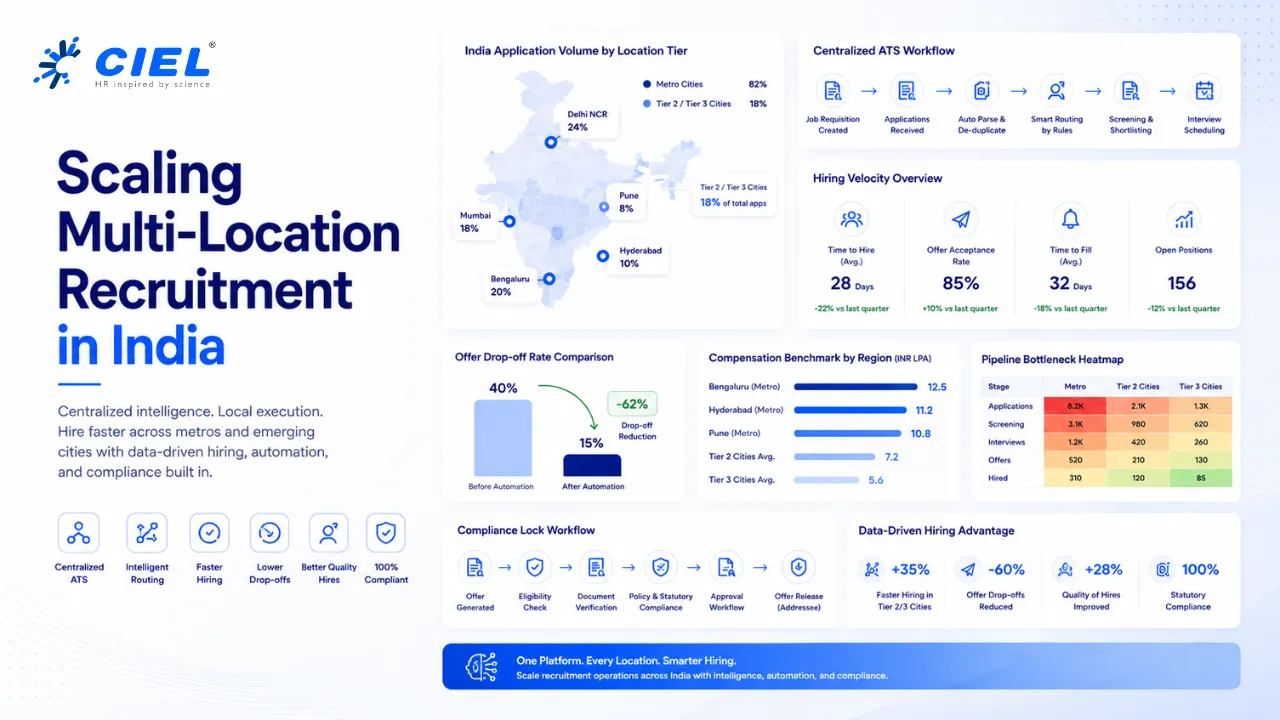
Scaling multi-location recruitment across Indian enterprises fractures talent acquisition pipelines between high-volume metros and emerging Tier-2 cities . A centralized recruitment platform consolidates applicant tracking, compensation benchmarking, and compliance protocols into a single operational layer. This standardization allows organizations to process high application volumes while reducing 30-40% offer drop-off rates and maintaining state-wise regulatory alignment.
What Are the Core Challenges in Scaling Multi-Location Recruitment in India?
Multi-location recruitment fractures talent acquisition pipelines across diverse geographic zones. This operational disconnect creates inconsistent candidate experiences. Enterprises lose visibility into regional hiring metrics, making it impossible to forecast workforce capacity accurately.
Expanding operations across India forces enterprises to manage two entirely different talent markets simultaneously. High-density metropolitan areas generate overwhelming application volumes, while Tier-2 and Tier-3 cities require localized employer branding and nuanced compensation models. The talent exists. The operational capacity to capture it consistently does not. Organizations struggle to balance the speed required to secure candidates in Bengaluru or Mumbai with the targeted outreach needed in emerging markets.
Most organizations attempt to solve this geographic complexity by decentralizing their hiring teams or applying a single metro-centric model across all regions. Decentralization creates fragmented data, inconsistent candidate experiences, and severe state-wise compliance risks. A rigid metro model, conversely, alienates regional talent and inflates salary expectations beyond local market realities, leading to a high cost of a bad hire when misaligned candidates eventually churn.
How Does a Scalable Recruitment Framework Unify Multi-Location Hiring?
A scalable recruitment framework standardizes employer branding, applicant tracking, and compensation benchmarking across distinct geographic zones. This integration aligns metro-level application processing with Tier-2 talent capture strategies. Enterprises maintain consistent hiring velocity without sacrificing regional compliance.
A centralized recruitment platform consolidates multi-location hiring data into a unified pipeline where enterprise talent teams standardize candidate evaluations, reducing offer drop-offs from 40% to under 15% within six months. By routing all inbound applications through a single ATS, the platform applies consistent screening rules regardless of where the candidate lives. This eliminates the manual sorting bottlenecks that paralyze regional HR teams during rapid expansion phases.
The framework also enforces compliance at the system level. Instead of relying on local managers to remember state-specific labor regulations, the platform locks the workflow. An offer letter cannot be generated until the required local statutory documents and localized contract terms are uploaded and verified. This mechanical enforcement removes human error from the expansion process.
What Does Recruitment Fragmentation Look Like in Practice?
Decentralized hiring operations isolate regional talent data from central oversight mechanisms. This fragmentation prevents enterprise teams from identifying pipeline bottlenecks in real time. Organizations absorb higher turnover costs due to localized misalignments.
A retail enterprise opens three new distribution centers in Pune, Jaipur, and Lucknow simultaneously. The central talent acquisition team in Bengaluru pushes the standard metro hiring playbook to regional managers. Within three weeks, the pipeline stalls. The Bengaluru team receives 4,000 applications for the Pune facility, overwhelming their manual screening capacity. Meanwhile, the Jaipur and Lucknow pipelines remain empty because the compensation bands reflect outdated Tier-3 estimates, causing local candidates to accept competing offers from regional startups.
The regional managers attempt to course-correct by adjusting offers locally and bypassing the central background verification protocol to speed up onboarding. This localized adjustment triggers state-level labor compliance flags during the quarterly audit. The enterprise absorbs the financial penalty of these violations, alongside the hidden costs of replacing 45% of the new hires who churn within 60 days due to role misalignment. That is decentralized hiring working exactly as designed. The activity occurs. The standardization does not.
The same expansion under a centralized recruitment platform plays out differently. On day one, the platform routes the 4,000 Pune applications through an automated parsing sequence, surfacing the top 50 matches based on predefined operational criteria. For Jaipur and Lucknow, the system flags the compensation disparity against real-time regional benchmarks before the roles are posted, forcing an adjustment that aligns with local market rates. The regional managers process candidates through a locked workflow that mandates state-specific compliance documentation before generating an offer letter. No one bypassed the protocol. The platform enforced the standard.
How Do Traditional Hiring Models Compare to Centralized Platforms?
A centralized recruitment platform replaces fragmented regional operations with a unified data architecture. This transition eliminates manual data silos and provides real-time visibility into hiring metrics across all geographic locations. Talent teams execute standardized workflows regardless of the candidate’s physical location.
| Feature | Centralized Recruitment Platform | Traditional Decentralized Model |
|---|---|---|
| Application Processing | Automated parsing and unified ATS routing | Manual screening via localized inboxes |
| Compliance Enforcement | System-locked workflows for state regulations | Ad-hoc verification by regional managers |
| Compensation Strategy | Real-time local market benchmarking | Static, metro-derived salary bands |
| Offer Drop-off Rate | Targeted reduction to under 15% | Consistently fluctuates between 30-40% |
Operational Authority Block: Recruitment Standardization Readiness
- Data Consolidation: ATS integration gap > 10% = FAIL. Action: Unify all regional data streams into a single API endpoint before expanding to new cities.
- Compensation Parity: Regional salary band deviation > 15% from local market median = HIGH RISK. Action: Implement real-time local benchmarking tools to align offers.
- Compliance Validation: State-level documentation bypass rate > 0% = FAIL. Action: Lock offer generation behind mandatory document upload protocols within the ATS.
Discover how standardizing your talent acquisition pipeline prepares your organization for scalable growth across all regions.
What Are the Trade-offs of Implementing a Centralized Recruitment Platform?
A centralized recruitment platform requires strict adherence to standardized workflows, which temporarily slows down localized hiring during the initial deployment phase. This transition period forces regional managers to abandon familiar ad-hoc processes in favor of governed protocols. The system prioritizes long-term compliance over immediate, unverified placements.
Considerations before implementation:
- Initial Deployment Friction: Regional teams must undergo training to adopt the central ATS, temporarily reducing hiring velocity in the first 30 days.
- Rigid Workflows: Managers cannot bypass background checks or compliance steps to secure a candidate quickly, which causes friction in highly competitive local markets.
- Data Migration Overhead: Consolidating historical applicant data from disparate regional spreadsheets into a single database requires dedicated IT resources and auditing.
How Can Enterprises Begin Standardizing Their Recruitment Operations?
Transitioning to a centralized recruitment platform requires a comprehensive audit of existing talent acquisition workflows. This evaluation identifies compliance gaps and data silos across regional offices. Enterprises establish a unified baseline before deploying automated screening technologies.
To start, organizations must map the specific compliance and compensation requirements for every state they operate in. Once these baselines are established, integrating a centralized recruitment platform ensures that every new application, regardless of origin, follows the exact same path from screening to offer generation.
Explore how a scalable recruitment framework aligns multi-location hiring strategies to build a consistent talent pipeline across India.
Frequently Asked Questions
How does a centralized recruitment platform integrate with existing HRIS infrastructure?
A centralized recruitment platform connects to existing HRIS databases via REST APIs, mapping local applicant data to central employee records. This integration ensures that candidate profiles flow directly into payroll and compliance modules upon offer acceptance without manual data entry.
What is the true cost of a bad hire in India and how does a standardized recruitment process help reduce it across multiple locations?
Replacing a bad hire costs enterprises between $5,000 and $15,000 in lost productivity and retraining expenses. A standardized recruitment process reduces this by enforcing strict evaluation rubrics and automated background checks, ensuring candidates meet baseline criteria before reaching the interview stage.
How can Indian companies manage high application volume in metros while reducing the 30-40% offer drop-off rates?
Companies manage high volumes by deploying automated resume parsing and initial screening assessments. Reducing drop-offs requires shortening the hiring cycle to under 15 days and maintaining continuous candidate communication through automated status updates from the central platform.
How to create a fair compensation strategy for hiring in Indian Tier-2 and Tier-3 cities without losing talent to metros?
Enterprises create fair compensation strategies by linking salary bands to real-time local cost-of-living indices rather than applying flat discounts to metro salaries. This approach ensures offers remain competitive against regional startups while maintaining internal pay equity.
What are the key state-wise compliance risks when scaling hiring in India and what tools can help manage them?
Key risks include varying state labor laws, local language contract mandates, and differing statutory deduction rules. Centralized recruitment platforms manage these risks by applying location-specific digital compliance checklists that block offer generation until all state-level documentation is verified.
What are effective strategies for building a strong employer brand in new, regional markets across India?
Effective strategies involve localizing job descriptions, partnering with regional universities, and highlighting career progression paths that do not require relocation to a metro office. A centralized platform distributes these localized campaigns while tracking engagement metrics from a central dashboard.
