

Table of Contents
Evaluating Greenfield Workforce Setup for India Facilities
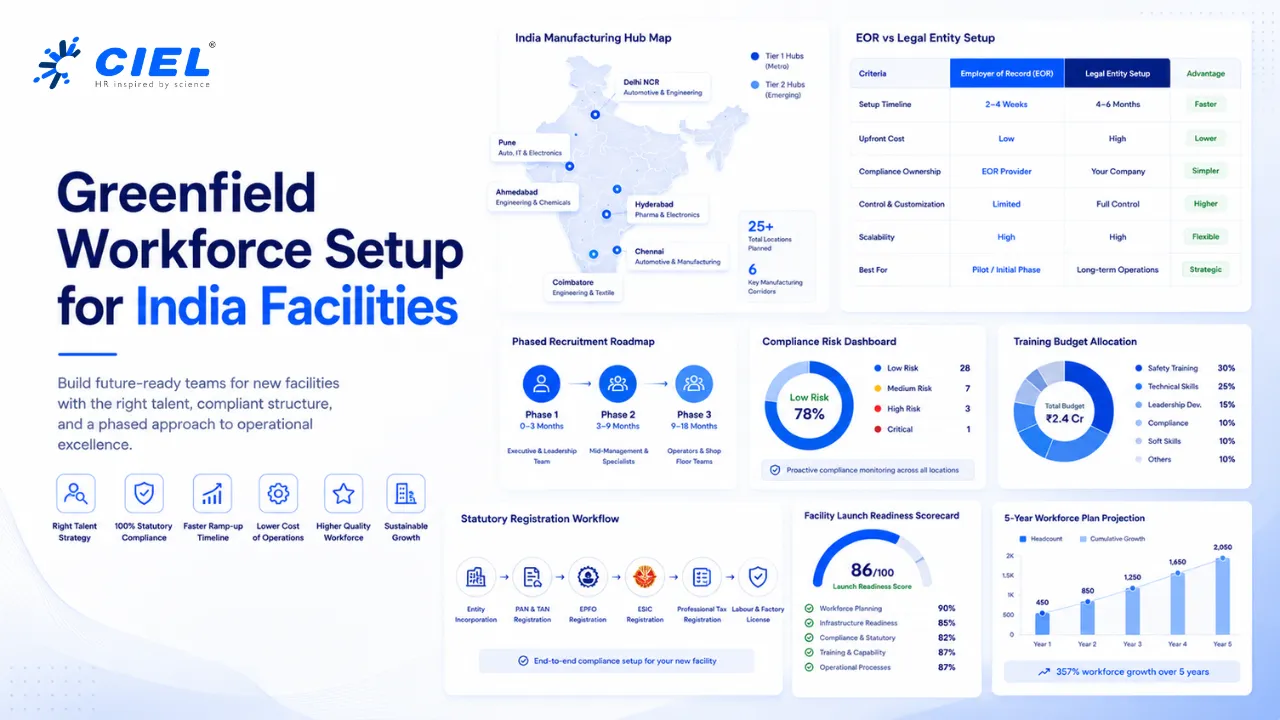
Evaluating greenfield workforce setup for new India facilities requires answering a fundamental question: do you establish a full legal entity or utilize an Employer of Record to manage local compliance and talent acquisition. Strategic workforce structuring aligns localized recruitment timelines with facility launch schedules. This approach mitigates statutory compliance failures across different Indian states and controls budget overruns related to skills training.
Many expansion teams treat the Indian labor market as a single, uniform jurisdiction. This evaluation framework fails because labor regulations, talent availability, and statutory compliance requirements vary heavily between states and municipalities. Applying a standardized global onboarding process without localizing the legal and operational framework guarantees launch delays.
How Do You Evaluate Workforce Setup Models for New Indian Facilities?
Greenfield workforce setup aligns local talent acquisition strategies with regulatory compliance frameworks. This alignment prevents launch delays and ensures operational readiness across manufacturing sites.
The core decision rests on risk transfer versus operational control. Establishing a full legal entity provides total control over corporate governance, intellectual property, and long-term equity structures. It also demands extensive upfront capital and assumes all local statutory liabilities. Conversely, an Employer of Record absorbs the legal liability of payroll , benefits, and local tax compliance, allowing the parent organization to focus entirely on production readiness.
To determine the correct path, operations directors must assess their expected headcount at month 12 and their tolerance for administrative overhead. If the facility requires rapid deployment of a specialized core team before heavy machinery arrives, third-party legal models accelerate the timeline. If the site demands immediate transfer of heavy capital assets and a workforce exceeding 500 operators, internal legal structures become necessary.
What Criteria Determine the Right Hiring Strategy Across Tier-1 and Tier-2 Cities?
Location-based recruitment frameworks analyze labor availability and statutory requirements across Indian municipalities. This analysis dictates whether a facility should target Tier-1 hubs or Tier-2 emerging markets .
Evaluating the pros and cons of hiring in Tier-1 vs. Tier-2 Indian cities for manufacturing talent requires analyzing wage arbitrage against infrastructure readiness. Tier-1 cities offer immediate access to experienced management talent and established supply chains. Tier-2 cities provide a 25-30% reduction in base labor costs and lower industrial real estate rates, but require heavier investments in foundational skills training.
When you budget for workforce setup and training costs in a greenfield project in India, the location dictates the allocation. Tier-2 facilities demand higher allocations for technical upskilling and relocation packages for senior engineers. Tier-1 facilities require higher base compensation budgets to combat the 15-20% annual attrition rates common in concentrated industrial zones.
What Happens When Global Manufacturers Misjudge Local Compliance Frameworks?
The expansion team for a European automotive supplier sat in their Frankfurt headquarters, reviewing the final launch schedule for their new Pune manufacturing plant. They budgeted standard global onboarding timelines and assumed their existing HRIS platform would handle local payroll compliance. The facility construction finished two weeks ahead of schedule. The machinery arrived. The workforce did not.
During the final pre-launch compliance audit, the local labor inspector flagged three critical violations regarding the Provident Fund registrations and state-specific female worker shift regulations. The internal HR team assumed national laws superseded state-level factory acts, missing the Maharashtra-specific mandates entirely. The launch halted immediately, pending documentation clearance.
Every day the machines sat idle cost the company $45,000 in delayed production quotas. The operations director scrambled to hire a local legal consultant to retroactively fix the documentation and register the employees under the correct state codes. A localized workforce partner catches these statutory gaps during the planning phase. Instead of a six-week delay, the facility opens on schedule with fully compliant shift rosters and pre-registered employee benefits.
How Does an Employer of Record Compare to a Full Legal Entity?
Entity structuring dictates the legal and financial responsibilities of foreign corporations operating in India. Selecting the correct model determines the required capital expenditure and time-to-market for the new facility.
| Feature | Employer of Record | Full Legal Entity |
|---|---|---|
| Setup Timeline | 2-4 weeks | 16-24 weeks |
| Compliance Liability | Transferred to partner | Retained by parent company |
| Upfront Capital Expenditure | Minimal (Service fees) | High ($50k-$150k baseline) |
| Asset Transfer Capability | Restricted | Unrestricted |
| Best For | Rapid deployment, <100 staff | Long-term manufacturing hubs |
What Are the Key Phased Timelines for Recruitment and Training?
Phased recruitment timelines sequence executive hiring , mid-level management onboarding, and operator training against the facility construction schedule. This sequencing guarantees that trained personnel are ready the moment machinery is commissioned.
To successfully integrate a global corporate culture with local Indian workplace expectations, teams must enforce strict readiness thresholds before the facility opens. The following operational authority block defines the pass/fail metrics for workforce readiness.
- Executive Lead Time: Plant manager search initiated < 90 days pre-launch = HIGH RISK. Threshold: Initiate search 120-180 days prior to facility opening. Action: Delay physical equipment delivery until local leadership is secured.
- Training Budget Allocation: Budget < 15% of initial year payroll = FAIL. Threshold: Allocate 15-20% for specialized operator training. Action: Restructure operational budget to fund technical upskilling before commissioning.
- Cultural Integration Readiness: Cross-cultural training < 20 hours per expatriate manager = HIGH RISK. Threshold: Mandate 40 hours of localization training. Action: Complete training modules prior to deployment to the Indian facility.
What Are the Trade-offs of Adopting an Employer of Record Model?
Employer of Record models utilize third-party legal entities to hire and pay local workers. This approach bypasses the need for immediate corporate registration but limits direct control over long-term employee equity programs.
Consider the following limitations before implementation:
- Not suitable when the facility requires importing heavy capital machinery, as customs clearances require a registered local corporate entity.
- Not suitable for workforces exceeding 200 operators, where the per-employee service fees outpace the cost of internal HR and legal administration.
- Not suitable if the parent company mandates direct issuance of stock options or localized equity sharing, which third-party entities cannot legally disperse.
Compare workforce deployment frameworks and evaluate Employer of Record agreements against legal entity setups to accelerate your greenfield launch.
Frequently Asked Questions
What are the key phases in a recruitment timeline for a new manufacturing plant in India?
The timeline requires three distinct phases. Executive leadership hiring must begin 120-180 days before launch. Mid-level engineering and management onboarding follows at 90 days. Floor operator recruitment and technical training must commence 45-60 days prior to machinery commissioning.
What are the most common compliance pitfalls when hiring for a new factory in India?
Organizations frequently fail to register for the Employees’ Provident Fund Organization (EPFO) and Employees’ State Insurance Corporation (ESIC) prior to the first payroll cycle. Additionally, ignoring state-specific regulations regarding female shift workers and mandatory local language documentation results in immediate operational halts.
How to budget for workforce setup and training costs in a greenfield project in India?
Financial planners must allocate 15-20% of the initial year’s total payroll strictly for pre-launch skills development. Budgets must also include statutory bonus provisions, gratuity accruals, and third-party compliance audit fees, which are mandatory under Indian labor laws.
What are the essential skills training programs needed for operators before a factory launch?
Operators require certified training in machine-specific safety protocols, lean manufacturing principles, and localized standard operating procedures (SOPs). Facilities must also conduct mandatory occupational health and safety (OHS) drills tailored to the exact equipment installed on the floor.
How do integration prerequisites differ between Employer of Record platforms and internal HRIS systems?
Integrating an Employer of Record requires mapping your global time-tracking data via API to the vendor’s localized payroll engine, demanding strict data formatting. Internal HRIS deployments require building custom tax calculation modules and direct API connections to Indian banking and government compliance portals.
What is the expected ROI timeframe when investing in pre-launch cultural integration programs?
Facilities that mandate 40 hours of cross-cultural training for expatriate managers achieve full production quotas 30-45 days faster than those that do not. This investment typically pays for itself within the first two months of operation by reducing early operator attrition and minimizing miscommunication-related downtime.
