

Table of Contents
Centralized multi-location hiring coordination standardizes recruitment workflows across geographically distributed enterprise branches by routing local requisitions through a unified applicant tracking system. This approach aligns employer branding across metro and Tier-2 regions while delegating interview execution to local managers. By consolidating compliance, payroll data, and talent pooling into one hub, organizations reduce cost-per-hire and maintain consistent candidate experiences regardless of the hiring site.
What is the Core Problem with Distributed Recruitment?
Decentralized recruitment models fragment the candidate experience and inflate operational costs when local branches manage their own sourcing and compliance. This fragmentation creates severe inconsistencies across regional offices.
Enterprises expanding across India frequently struggle to maintain control over talent acquisition when regional offices operate in silos. A branch in Mumbai might deploy a highly structured, digitally native onboarding process, while a new distribution center in a Tier-3 city relies on manual paper trails and localized vendor networks. The business problem is not a lack of candidates; it is the total absence of operational visibility and standardized quality control across disparate geographic zones.
This problem persists because legacy organizational structures treat recruitment as an administrative localized task rather than a centralized strategic function. Local hiring managers often lack the training or the technological infrastructure to execute enterprise-grade talent acquisition. Consequently, the central human resources team loses sight of requisition statuses, regional compliance mandates , and employer brand consistency.
How Does a Centralized Recruitment Strategy Impact Cost and Efficiency?
Centralized recruitment orchestration integrates regional talent requisitions into a unified applicant tracking system to standardize workflows and automate compliance tracking. This consolidation reduces the overall cost-per-hire by eliminating redundant agency fees and accelerating time-to-fill metrics.
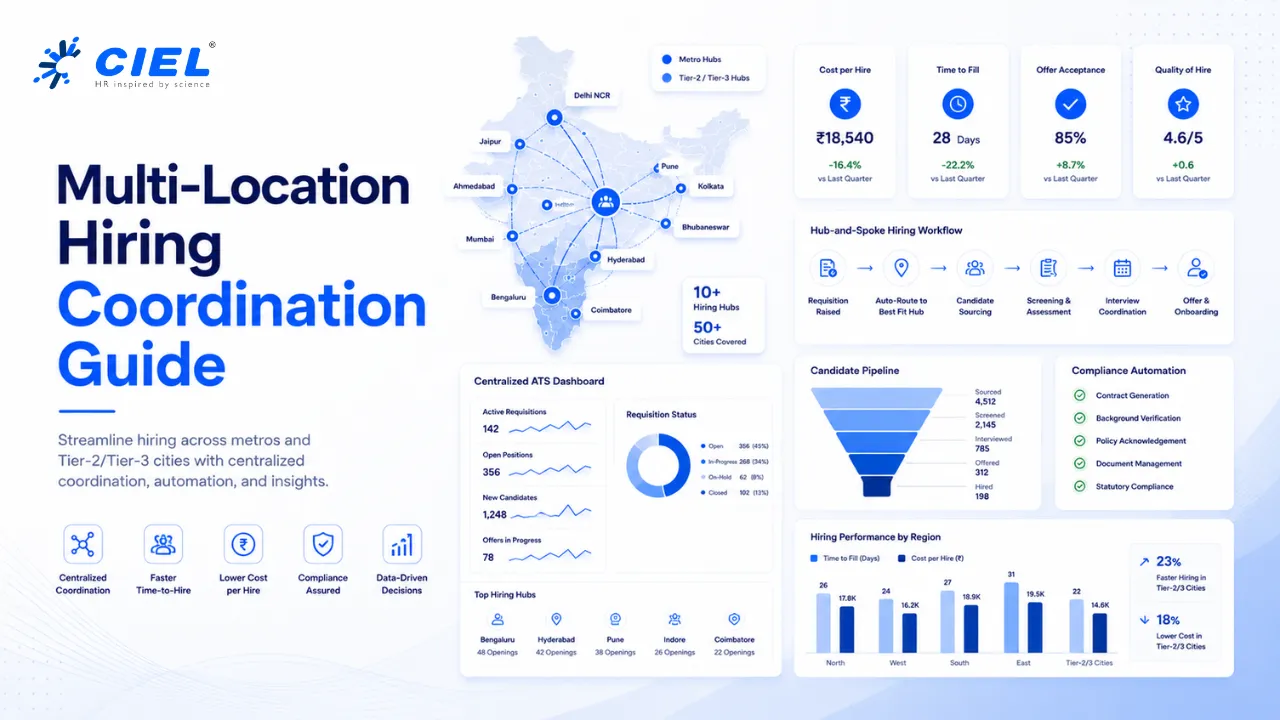
Multi-location hiring coordination functions as a centralized hub-and-spoke model. The central human resources team controls the employer brand, digital sourcing channels, and initial candidate screening, while local hiring managers handle final interviews and site-specific assessments. What are the essential features of an applicant tracking system for managing hiring across multiple Indian locations? They include multi-site requisition routing, localized compliance checklists, and automated offer generation tailored to specific state labor laws.
By routing all data through one unified system, the enterprise achieves a 30-40% reduction in redundant job board spending. More importantly, this structure answers how to standardize the candidate experience for a company recruiting in different states across India, ensuring that every applicant receives the same communication cadence whether they apply in Delhi or Hubli. How does a centralized recruitment strategy impact the overall cost-per-hire for a business with offices across India? It consolidates vendor contracts at the corporate level, stripping away the premium markups charged by localized, unvetted staffing agencies.
What Happens When Multi-Site Hiring Lacks Coordination?
Disconnected local hiring processes obscure operational visibility, allowing regional facilities to accrue unapproved vendor costs and delay critical onboarding phases. Implementing centralized oversight eliminates these blind spots by routing all requisition data through a singular control dashboard.
A regional logistics hub in Coimbatore operates with a critical shortage of warehouse supervisors just weeks before the peak festive season. The local facility manager, desperate to fill three shifts, bypasses the corporate career portal and engages an unvetted local staffing agency. Resumes are exchanged via personal email threads, and interviews happen on the warehouse floor with no standardized assessment rubrics. The corporate human resources team in Bengaluru remains entirely unaware of the active requisition or the agency fees being accrued.
Two weeks later, the candidates are hired, but the onboarding process stalls because the local manager lacks the correct regional compliance forms for payroll processing. The new hires sit idle in the breakroom for three days while local administration scrambles to align with state-specific labor regulations. The candidates experience profound frustration, and the local agency submits an invoice that is 40% higher than the corporate standard rate. This is decentralized hiring failing in real time. The headcount was filled, but the operational efficiency was destroyed.
Under a coordinated multi-location hiring platform , this scenario shifts fundamentally. When the Coimbatore hub identifies a supervisor shortage, the manager triggers a digital requisition within the enterprise applicant tracking system. The system instantly publishes the approved job description, aligned with the corporate employer brand, to targeted regional job boards. Central human resources screens the initial influx, forwarding only the top five validated profiles to the local manager’s dashboard. Compliance documents are automatically routed based on the facility’s geographic code. The facility manager focuses solely on interviewing, while the system handles the administrative load.
What Are the Key Performance Indicators for Multi-Location Hiring?
Standardized recruitment analytics measure the performance of distributed hiring models by tracking time-to-fill, cost-per-hire, and first-year retention rates across all geographic zones. These metrics provide central leadership with actionable data to optimize regional talent acquisition workflows .
Establishing a baseline for success requires strict data tracking across all operational nodes. What key performance indicators should be used to measure the success of a multi-location hiring strategy? Enterprises typically monitor the variance in time-to-fill between metro hubs and Tier-2 facilities, aiming to keep discrepancies below 15%. Additionally, tracking the offer acceptance rate by region highlights potential misalignments in local compensation strategies or employer branding.
To enforce this, organizations must apply a structured evaluation model to their regional operations:
- Time-to-Fill Variance: Metro vs Tier-2 time-to-fill discrepancy >15% = HIGH RISK. Discrepancy <10% = PASS. Action: Centralize sourcing budgets and deploy targeted regional campaigns if high risk.
- Agency Spend Ratio: Localized agency fees >20% of total recruitment budget = HIGH RISK. Ratio <5% = PASS. Action: Mandate corporate applicant tracking system usage for all requisitions.
- Compliance Deviation: Missing state-specific onboarding documents >2% = FAIL. Deviation 0% = PASS. Action: Automate document routing based on geographic facility codes.
How Do Enterprises Compare Centralized vs Localized Hiring Models?
Evaluating recruitment models requires comparing centralized orchestration against traditional localized hiring across dimensions of compliance, cost, and brand consistency. Centralized systems natively enforce standardization, whereas localized approaches prioritize immediate regional autonomy at the expense of oversight.
| Feature | Coordinated Multi-Location Approach | Traditional Localized Hiring |
|---|---|---|
| Sourcing Strategy | Unified employer brand across all regions | Fragmented, agency-dependent sourcing |
| Compliance Management | Automated state-specific payroll & legal checks | Manual, error-prone local paperwork |
| Cost Control | Consolidated vendor contracts, lower cost-per-hire | Unpredictable, high redundant agency fees |
| Candidate Experience | Standardized communication and digital onboarding | Highly variable based on local manager |
What Are the Considerations Before Implementing Multi-Site Coordination?
Deploying a unified hiring framework across diverse geographic regions requires navigating localized labor constraints and varying levels of technological maturity among local managers. Organizations must account for these structural differences to prevent adoption bottlenecks.
Local facility managers in Tier-3 cities may lack familiarity with enterprise-grade applicant tracking systems, necessitating extensive change management and training. Furthermore, what are the common compliance and payroll challenges when expanding hiring into Tier-3 Indian cities and how to solve them? State-specific labor laws, varying minimum wage structures, and local statutory bonuses require highly configurable payroll integrations within the central platform.
Organizations must also establish clear operational boundaries. What is the best way to structure the roles of a central HR team versus local hiring managers for effective multi-site recruitment? Without strictly defined service level agreements (SLAs), bottlenecks occur when local managers wait too long for central human resources to screen candidates. The central team must commit to a 48-hour turnaround for initial screening, while local managers must commit to executing interviews within five days of receiving validated profiles.
Discover how modern applicant tracking frameworks can unify your regional talent acquisition efforts and streamline enterprise-wide growth. Take the next step by evaluating your current multi-location workflows against industry standards.
Frequently Asked Questions
How does a centralized applicant tracking system integrate with local payroll software?
A centralized applicant tracking system utilizes REST APIs to push hired candidate data directly into regional human resources information systems and payroll platforms. This ensures that state-specific tax codes and compliance mandates are automatically applied without manual data entry.
What is the typical ROI timeframe for consolidating multi-location hiring tools?
Enterprises observe a positive return on investment within 6 to 9 months. This is driven by a 30% reduction in localized agency spend and a significant decrease in administrative hours spent on redundant compliance checks.
How does centralized recruitment orchestration actually work?
A central human resources hub configures job templates, manages digital sourcing channels, and conducts initial screening. Validated candidate profiles are then routed via the applicant tracking system to local facility managers who conduct final interviews and submit hiring decisions through the platform.
How can an enterprise in India maintain a consistent employer brand when hiring in both metro and Tier-2 cities?
Organizations maintain brand consistency by centralizing the creation of job descriptions, career site portals, and automated candidate communications. Local managers execute interviews, but all external messaging flows through centrally approved digital templates.
Are there limitations to using a centralized hiring model in remote locations?
Yes, highly centralized digital models can struggle in areas where online talent sourcing is ineffective. In these cases, the applicant tracking system must be flexible enough to ingest offline applicant data gathered through local community drives or walk-in events.
