

Table of Contents
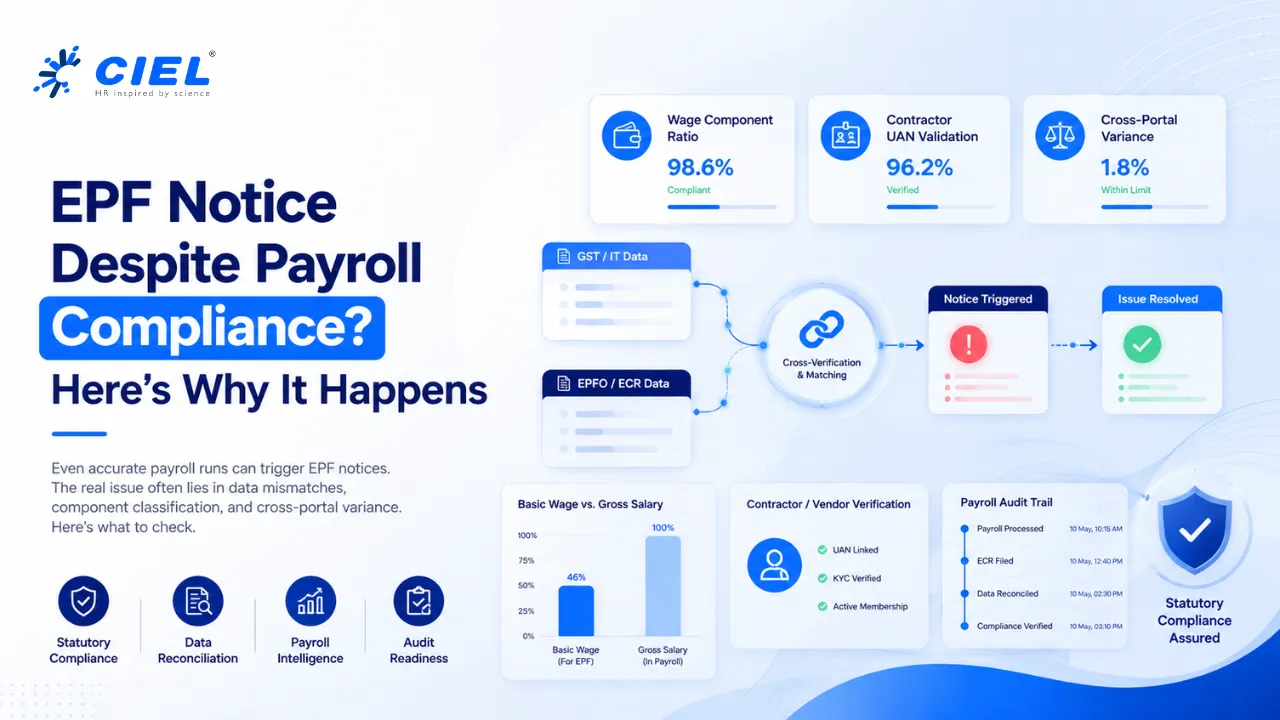
Finance and HR directors constantly evaluate why their organizations face statutory inquiries despite running rigorous monthly payroll cycles. The core evaluation question is no longer whether a company files its Electronic Challan cum Return (ECR) on time, but whether that ECR data survives algorithmic cross-validation against other statutory filings . Indian companies frequently receive automated EPF notices because legacy payroll systems fail to reconcile internal provident fund data with external GST and Income Tax portal filings. The Employees’ Provident Fund Organisation (EPFO) deploys data analytics to cross-reference these databases, flagging discrepancies in basic wage calculations and contractor compliance. Automated compliance platforms integrate API endpoints across EPFO, GST, and IT portals to continuously reconcile wage data, eliminating the data mismatch triggers that generate Section 7Q and 14B penalty notices.
Why do traditional payroll compliance evaluations fail?
Traditional payroll compliance evaluations rely on isolated ECR generation, failing to detect when special allowances are improperly excluded from basic wage calculations following recent Supreme Court rulings. This siloed approach leaves companies exposed to automated data analytics sweeps that cross-reference EPFO submissions with corporate tax filings.
Most organizations evaluate their payroll success based on internal processing speed and timely bank dispatches. However, common payroll blind spots arise from wage structuring. When companies split salaries into numerous special allowances to reduce the provident fund burden, legacy systems simply process the math as instructed. They do not evaluate whether those allowances are universally paid to all employees, which dictates whether they should be included in the basic wage for EPF calculation. When the EPFO algorithms detect an unusually low ratio of basic wages to gross salary, an automated inquiry is generated.
What criteria separate effective EPF compliance frameworks from risky ones?
An effective EPF compliance framework utilizes automated ECR audits and continuous contractor verification to synchronize principal employer records with vendor UAN data. This proactive reconciliation prevents the EPFO from assigning default liability to the principal employer for a contractor’s missing deposits.
To evaluate the resilience of a payroll compliance operation, finance teams must implement strict validation thresholds before any ECR is finalized or any vendor invoice is paid. Relying on self-declared compliance certificates from outsourced manpower agencies is a primary failure point.
- Wage Component Ratio: Special allowance ratio > 50% of gross salary = HIGH RISK. Action: Mandate legal review of the allowance structure against the latest Supreme Court definitions of basic wages.
- Contractor UAN Validation: Vendor TRRN generation rate < 100% for deployed UANs = FAIL. Action: Withhold all vendor payments until the missing contractor EPF deposits are mathematically proven.
- Cross-Portal Variance: Manpower expense deviation > 5% between GSTIN filings and ECR payloads = HIGH RISK. Action: Isolate the exact data mismatch and reconcile the ledger before the tax filing deadline.
How does a data mismatch trigger an automated EPFO inquiry?
The EPFO data analytics system cross-references employer ECR payloads with GST and income tax portals, identifying discrepancies between declared corporate labor expenses and actual provident fund deposits. This algorithmic inspection triggers automated notices under Section 7Q and 14B without requiring a manual inspector visit.
A mid-sized manufacturing firm in Pune completes its vendor evaluation for a new payroll outsourcing partner . The finance committee selects a vendor based entirely on processing speed and base cost, assuming that timely ECR filing equates to statutory safety. The chosen vendor processes the monthly payroll, generates the challans, and the firm pays exactly on the 15th of every month. The internal compliance dashboard shows green across all internal metrics.
Six months later, the finance director receives a digital notice from the EPFO citing a massive discrepancy in contractor payments, accompanied by a demand for financial penalties and interest for late EPF deposits under Section 7Q and 14B. The evaluation process had completely missed the need for principal employer liability tracking. The selected payroll vendor only processed the firm’s direct employees, while the procurement team handled 400 contract workers without verifying their individual Universal Account Numbers (UAN) against the vendor’s Electronic Challan cum Return (ECR).
The EPFO’s analytics engine simply cross-referenced the firm’s GST filings—which claimed heavy input tax credits for “manpower supply services”—against the provident fund portal, which showed zero corresponding EPF deposits for those specific contract workers. The principal employer was instantly hit with the liability. A proper evaluation framework that included mandatory contractor UAN validation and cross-portal reconciliation would have flagged the missing vendor TRRNs before a single invoice was cleared.
What is the step-by-step process for responding to an EPF notice?
A structured response protocol for an EPF data mismatch notice involves immediate data isolation, wage component reconciliation, and evidence submission through the EPFO portal. Executing this sequence within the mandated 15-day window prevents the escalation of financial penalties and interest for late EPF deposits under Section 7Q and 14B.
- Step 1: Isolate the Mismatched Data Payload. Extract the specific ECR files and cross-reference them against the exact GSTIN filings for the disputed period to locate the mathematical variance.
- Step 2: Execute an ECR Audit. Analyze the wage components to identify if special allowances were incorrectly excluded from the basic wage calculation, or if the variance stems from unregistered contract labor.
- Step 3: Compile Vendor TRRN Evidence. Gather the UAN and Temporary Return Reference Number (TRRN) receipts for all contract workers flagged in the inquiry to prove the vendors deposited the funds.
- Step 4: Submit the Technical Response Payload. Upload the reconciled data files and legal justifications through the EPFO employer portal within the 15-day compliance window.
How do modern compliance tools compare to legacy processing?
Modern enterprise compliance platforms utilize API-driven validation to compare internal wage registers against external statutory portals in real time. This active reconciliation reduces the risk of automated notices by up to 95% compared to legacy offline spreadsheet processing.
| Feature | Modern Compliance Platform | Legacy Offline Processing |
|---|---|---|
| Data Reconciliation | Real-time API cross-validation with GST and IT portals | Siloed, manual ECR generation based only on internal data |
| Contractor Tracking | Automated UAN and TRRN verification before vendor payout | Blind trust in vendor compliance certificates and physical invoices |
| Wage Structuring | Algorithmic checks against Supreme Court basic wage definitions | Manual allowance classification vulnerable to human error |
| Audit Readiness | Continuous ECR audits and anomaly detection dashboards | Reactive data gathering during an active EPFO inquiry |
What are the limitations of automated EPF compliance systems?
Automated EPF compliance systems require accurate foundational data and cannot legally substitute for manual legal interpretation during complex tribunal disputes. Organizations must recognize these constraints before fully dismantling their internal compliance advisory teams.
- Not suitable when historical data prior to UAN implementation (pre-2014) requires manual physical reconciliation from paper ledgers.
- Requires strict vendor cooperation; automated contractor tracking fails if vendors refuse to share TRRN data or format their invoices to system standards.
- Cannot automatically resolve physical inspections or Section 7A tribunal hearings without human legal representation.
Evaluate your current payroll infrastructure against the latest statutory cross-validation standards to prevent algorithmic compliance notices before they are generated.
Frequently Asked Questions
What technical prerequisites are required to implement automated ECR audit software?
Implementing automated ECR audit software requires active API access to the company’s core HRIS database , structured JSON wage component data, and authenticated credentials for the EPFO employer portal to enable continuous validation.
What is the typical ROI timeframe for deploying an enterprise payroll compliance platform?
Organizations typically achieve a positive ROI within 4 to 6 months. This return is driven by the immediate elimination of Section 7Q interest payments and the reduction of manual hours spent reconciling vendor TRRN receipts.
How does the EPFO cross-reference information with GST and income tax portals mechanically?
The EPFO data analytics system ingests employer PAN and GSTIN identifiers, pulling automated data feeds from the tax portals. It compares the gross manpower expense claimed for tax credits against the aggregate wage data submitted in the monthly ECR payloads.
Can compliance software automatically negotiate financial penalties under Section 14B?
No. While compliance software prevents the data mismatches that trigger initial notices, it cannot negotiate or legally represent a company during a physical Section 7A tribunal hearing regarding Section 14B damages.
How do companies verify a contractor’s EPF compliance to avoid liability notices?
Companies verify contractor compliance by requiring vendors to submit a UAN-level breakdown of their monthly ECR alongside the TRRN payment receipt. The principal employer then cross-validates these UANs against their active facility access logs before clearing invoices.
